
The invite says mehndi on Friday, sangeet on Saturday, the ceremony on Sunday morning and the reception that night, and not a word about dress codes. What to wear to an Indian wedding, for a male guest, starts with matching the outfit to the event, and with 1 conversation with your hosts before you buy anything.
Most men reading this are guests, so that is the frame here, with a section for close family and the wedding party below. A common path: a kurta set or a kurta with a Nehru jacket for the daytime events and the ceremony, and a bandhgala or a dark suit for the reception.
Scope: this guide suggests outfits for several functions an invitation might list: mehndi and haldi (separate functions, grouped here for outfit advice), sangeet, ceremony and reception. Region, faith, family, venue and the invitation itself set the actual dress code, and 2 weddings in the same city can run on different rules. Where anything below disagrees with what your hosts tell you, follow your hosts. Ask them about attire, reserved colors and head covering before the week of the wedding.
The Invite Tells You Nothing
The card says something warm about celebrating love, gives you 3 dates and 4 venues, and answers none of the questions you actually have. Is the sangeet formal? Can you wear a suit to the ceremony? Are jeans with a kurta fine or an insult? You have 1 suit, 0 kurtas and 2 weeks.
Many celebrations in this format follow a similar shape: daytime events run relaxed, the ceremony carries the most tradition, and the evening reception is often the most relaxed about dress. That is a common pattern, not a protocol, and the family hosting your wedding sets the real code. The Knot’s guide to Indian wedding attire for men is a useful reference for the garments themselves, the kurta, the bandhgala and the sherwani, and it stresses how much the traditions vary by region and family. The outfit suggestions below are FashionXD’s own.
3 Questions to Settle Before Any Outfit
1. Which colors are reserved? Red is a widely cited caution: it is a classic bridal color, so an entirely red or maroon outfit can read as reserved territory. Not every bride wears red, and not every family reserves it, which is exactly why the move is to ask. Planners interviewed by Brides give the same advice: if you are in doubt, ask the couple, their planner or someone in the wedding party about reserved colors and the family’s palette.

2. What do white and black mean to this family? Neither rule is uniform. White carries mourning associations in some Hindu traditions, and black reads somber at some ceremonies and perfectly sharp at some receptions. The family’s answer decides, so fold it into the same question. Until you have an answer, the safer move is an outfit with some color in it rather than an entirely white or entirely black one.
3. What does the venue expect? This is the 1 question with firm answers at some venues. At a gurdwara, the Sikh place of worship, everyone removes their shoes and covers their head before entering the prayer hall, and clothing should cover shoulders and knees and stay comfortable for sitting on the floor. The Sikh Coalition’s gurdwara guide and its visitor PDF add that most gurdwaras keep spare head coverings at the entrance, and that a scarf, bandana or cloth works where a hat does not. Other venues carry their own expectations, so check the venue’s or the family’s instructions instead of assuming the same rules everywhere.
What Guests Often Wear, Function by Function
An invitation might list some or all of these events, sometimes across several days. Formality and tradition often differ between them, so an outfit aimed at 1 event can miss at another. The menu below is FashionXD’s suggestion for a male guest, a starting point to adjust once your hosts answer the questions above.
Mehndi and haldi
Vibe: daytime, relaxed
A common guest outfit: light cotton or linen kurta in a pastel or a bright day color, with churidar or slim trousers
Footwear: mojaris or clean loafers
Sangeet
Vibe: evening, music and dancing
A common guest outfit: kurta with a Nehru jacket, in a jewel tone or a dark evening color
Footwear: juttis or mojaris you can move in
Ceremony
Vibe: often the most traditional event
A common guest outfit: a richer kurta set, for example silk or a silk mix, in cream, gold or jewel tones
Footwear: mojaris or dress shoes
Reception
Vibe: evening, often the most relaxed about dress
A common guest outfit: bandhgala, or a dark suit with a festive pocket square
Footwear: leather dress shoes
Mehndi and haldi (daytime, relaxed). The casual end of the celebration. A light cotton or linen kurta in a pastel or a bright day color, with churidar, slim trousers or even clean dark jeans. This is also the event most likely to end with turmeric or henna on your clothes, so skip anything you would cry over.
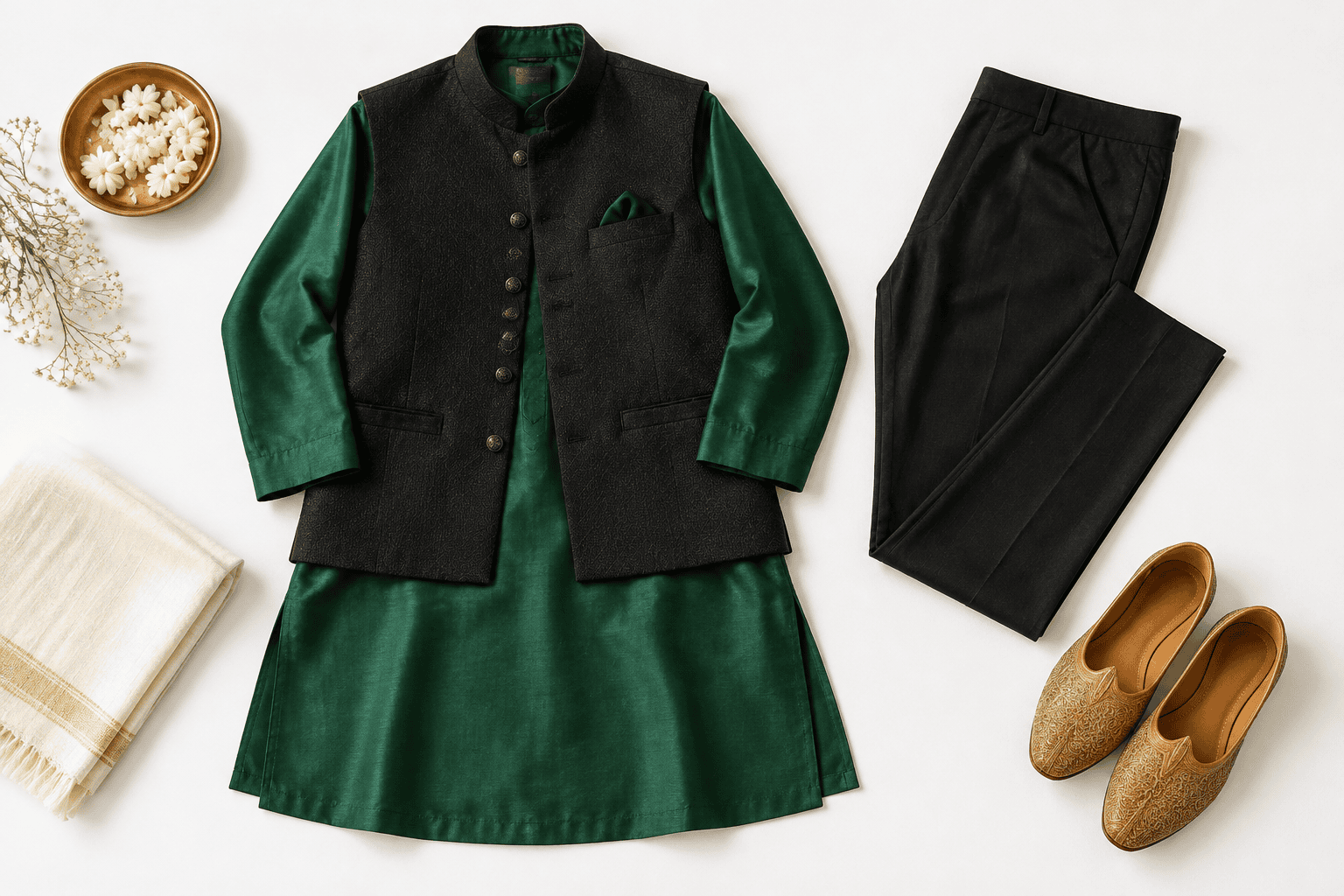
Sangeet (evening, dancing). The one you will be moving in. A kurta with a Nehru jacket over it, in a jewel tone or a darker evening color, with mojaris or juttis. Our styling preference, not a rule: let 1 piece carry the embroidery and keep the other plain. The guide to mixing Indian and Western outfits covers how to keep the combination sharp.
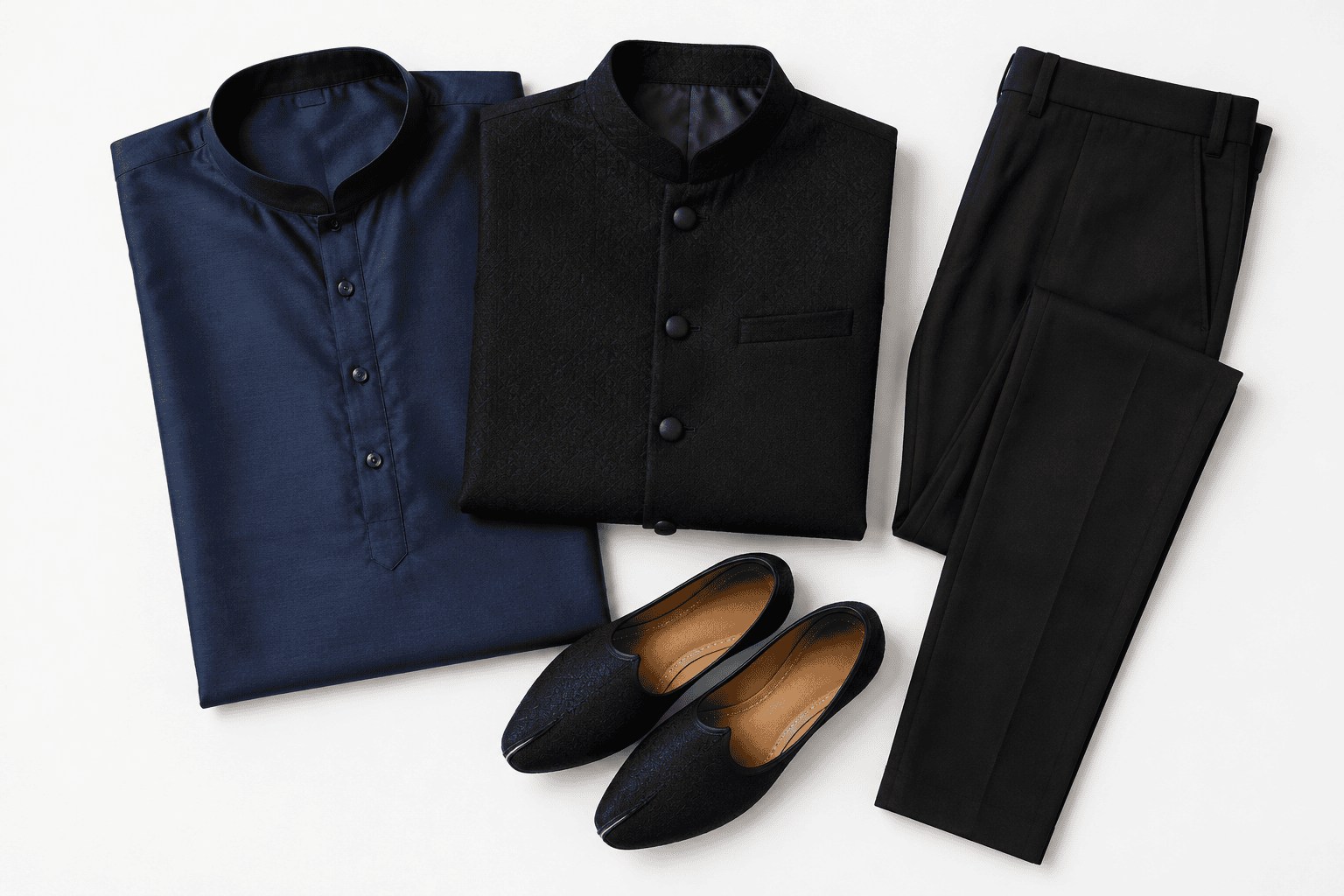
The ceremony (the traditional center). For many families this is the most formal and most traditional event, though the level is theirs to set. A richer kurta set in silk or a silk mix, or a kurta with an embroidered Nehru jacket, in cream, gold, jewel tones or pastels. A sherwani is welcome on a guest when the hosts or the dress code invite that level of formality, so ask before you rent 1.
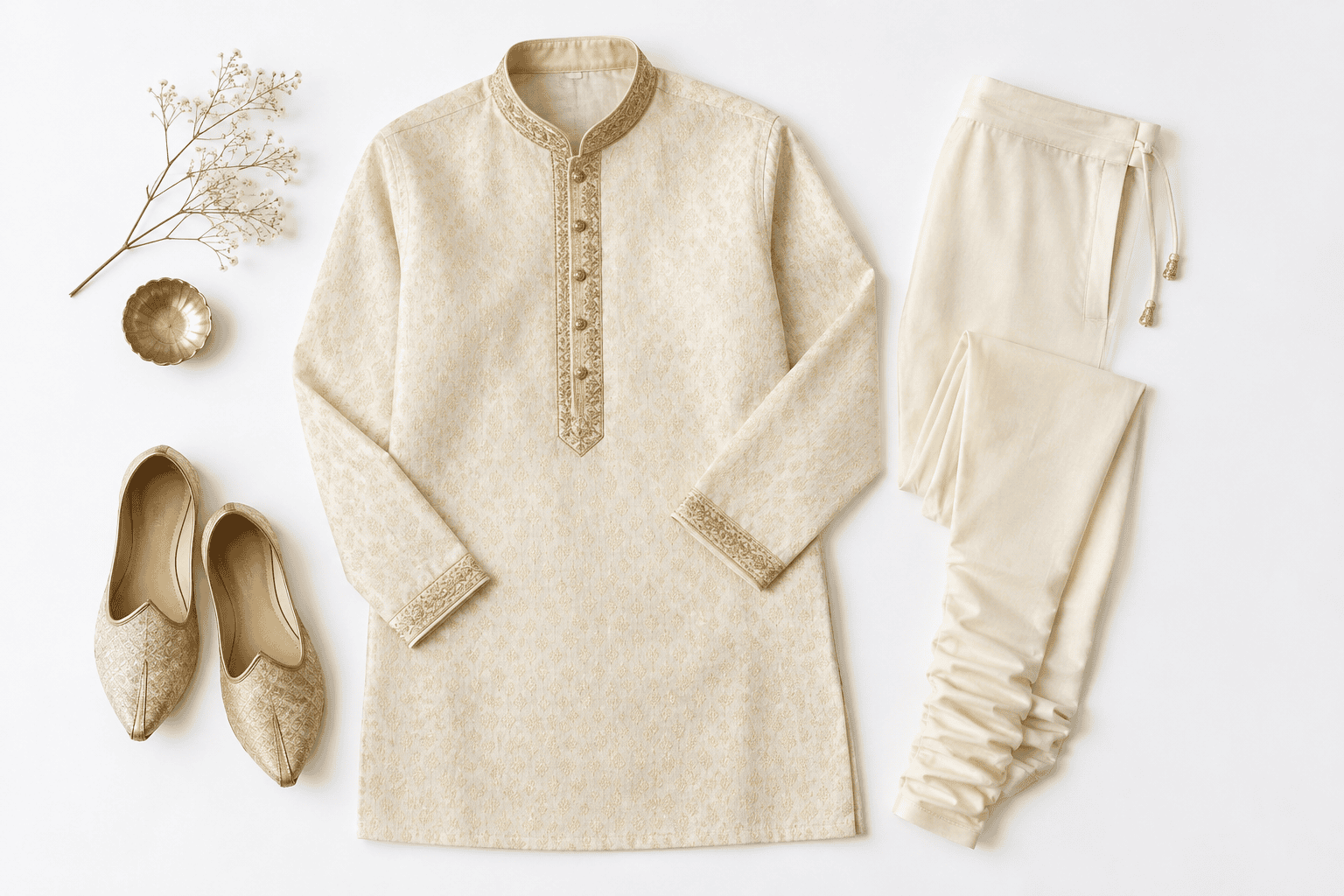
The reception (the evening event). Many receptions are relaxed about dress codes, and suits are common at them, but some families keep the reception formal, so check. Where suits are welcome, a bandhgala is a strong choice: structured, formal and rooted in Indian design without repeating the ceremony’s register. A dark suit with a pocket square in a festive color is widely worn.

4 Outfit Formulas That Work
Formula 1, the daytime guest. Light blue or mint cotton kurta, beige churidar or slim chinos, tan mojaris or loafers. Mehndi, haldi and daytime family functions. What breaks it: sandals with visible wear.
Formula 2, the sangeet. Deep green or navy kurta in silk or a silk mix, a plain black or textured Nehru jacket, slim black trousers, black or tan juttis. Built to dance in, which matters, because you will. What breaks it: heavy embroidery on both the kurta and the jacket. Our preference is 1 decorated piece; yours can differ.
Formula 3, the ceremony. Cream or gold kurta set with a Nehru jacket in a color outside the family’s reserved shades, and mojaris. What breaks it: squeezing into a kurta from years ago. Check the shoulders and the length you prefer against the fit notes in that guide.
Formula 4, the reception. Black or midnight blue bandhgala, tonal trousers, black leather dress shoes. The bandhgala does all the work, so our preference is to keep accessories to a watch and at most 1 pocket square, the single focal point idea from the accessories guide.
If You Are Close Family or in the Wedding Party
The suggestions above keep a guest comfortably out of the spotlight. If you are the groom’s brother, a cousin or named in the wedding party, families often expect 1 level up: a sherwani or a richly textured bandhgala at the ceremony, with heavier embroidery read as fitting the role rather than showing off. Coordinate colors with the family early, because wedding party photos run for decades. Comfort still matters: you will stand, greet and pose for hours.
Comfort for a Very Long Day
Wedding days run long, sometimes across venues, and the outfit that felt fine at noon gets judged again at midnight. Three checks beat any rule.
Fabric. Weight matters more than prestige. Heavier silks and brocades photograph richly; lighter cotton and linen feel easier through a long afternoon. Check the fabric weight against the actual weather and venue rather than assuming the evening will be cool.
Shoes. Mojaris and juttis often have thinner soles than the dress shoes you are used to, and hours of standing are unkind to any thin sole. Test the cushioning at home for a few evenings before the event, and choose a padded insole if you expect to be on your feet for hours. At the reception, shoes you already know are comfortable are the sensible pick.
Fit. Wedding kurtas can run long and boxy off the rack. Some men prefer a hem around the middle of the thigh with slim trousers because it lengthens the leg line in photos. Treat that as a styling choice, not a rule. If you want a different length, ask a tailor about feasibility, price and lead time well before the event.
What Not to Wear
- Head to toe deep red or maroon, without asking. Red is a widely cited bridal color caution, and the couple may reserve these shades. Some families do not, so this is a question, not a law.
- An entirely white or entirely black outfit at the ceremony, without asking. The associations differ by family and tradition, so treat both as reserved until the hosts say otherwise.
- Jeans at the ceremony or reception, in most families. Daytime functions are where denim, dark and clean, sometimes passes.
- Sneakers past the mehndi. A taste call rather than a ban. Our preference: loafers, mojaris or dress shoes for the ceremony and reception.
- Gym fabrics and big logos. They read underdressed at these events.
- A sherwani grander than the groom’s. A look most men would rather avoid, though that is taste, not etiquette law.
The short version: match the outfit to the function, and ask your hosts about attire, reserved colors and head covering before you buy. Daytime events often call for a light kurta set, the sangeet for a kurta with a Nehru jacket, the ceremony for a richer kurta set (a sherwani when the hosts welcome it) and the reception for a bandhgala or a dark suit. Break your shoes in before the day, and follow the family over any guide, including this 1.
FAQs
What should a man wear to an Indian wedding?
Match the outfit to the function, and ask the hosts about reserved colors and venue requirements. Daytime events often call for a light kurta set, the sangeet for a kurta with a Nehru jacket, the ceremony for a richer kurta set or a sherwani when the dress code invites it, and the reception for a bandhgala or a dark suit. Plan for long hours on your feet.
Can a man wear a suit to an Indian wedding?
Often, yes. A dark suit with a festive pocket square is common at receptions, and some ceremonies welcome suits too. A kurta set or a bandhgala fits the ceremony’s tradition more closely, and a guest from any background wearing 1 is usually read as a gesture of respect. The hosts and the invitation have the final word.
What colors should male guests avoid at an Indian wedding?
Ask first, because the rules are not uniform. Deep red and maroon are widely cited bridal color cautions, and white and black carry mourning or somber associations in some traditions and families while being fine in others. Jewel tones like emerald, sapphire and deep purple, plus pastels for daytime, are widely worn by guests.
Is it OK for guests from outside the culture to wear a kurta?
Yes, when the invitation welcomes it. Follow the hosts’ invitation and the venue’s customs; a welcomed kurta worn as a guest reads as respect for the occasion.
What should a man wear to a sangeet?
A kurta with a Nehru jacket over it, in a jewel tone or a dark evening color, slim trousers and juttis or mojaris. The sangeet is a dance event, so pick shoes you can move in and a jacket you can take off.
Do you need a different outfit for each function?
Not necessarily. Formality often differs between events, but 2 outfits can cover 3 days: a lighter kurta combination for the daytime functions and the sangeet, and a richer set or a bandhgala for the ceremony and reception. Rewearing across days is a practical option many guests use.
Can men wear black to an Indian wedding?
It depends on the family and the event. A black bandhgala or suit is a strong reception choice at many weddings, while an entirely black outfit reads somber to some families at daytime events and ceremonies. Ask the hosts, and when in doubt include some color.