

How to Match Clothes Colors for Men: The Foolproof 6-Neutral System
By Ghoul, FashionXD. Last updated November 11, 2026.
Don’t know how to match clothes colors for men? The easiest way to match clothes colors for men is the 2+1 Rule: build every outfit on 2 neutral base pieces and add at most 1 stronger accent color. Because navy, grey, black, white, beige, and olive pair effortlessly with each other, 80% of your matching work is finished before a single colored piece leaves the hanger.
Why Color Matching Feels Harder Than It Is
Pull open your closet and look at the rack: three graphic tees, an impulse-buy burgundy hoodie, and a checkered shirt that only pairs with one specific pair of jeans. The morning dressing struggle happens because of your buying order.
A bright, colored piece catches your eye in the store, so you buy it first and try to build an outfit around it later. The burgundy hoodie isn’t the problem—it just arrived before you had the neutral foundation to wear it over.
Your fix is reversing that order: neutral basics first, accent pieces second. Take a count of your closet tonight. If fewer than half of your shirts, sweaters, and trousers are navy, grey, black, white, beige, or olive, you have already diagnosed why getting dressed feels difficult.
Build the Base: 6 Neutrals That Carry Everything
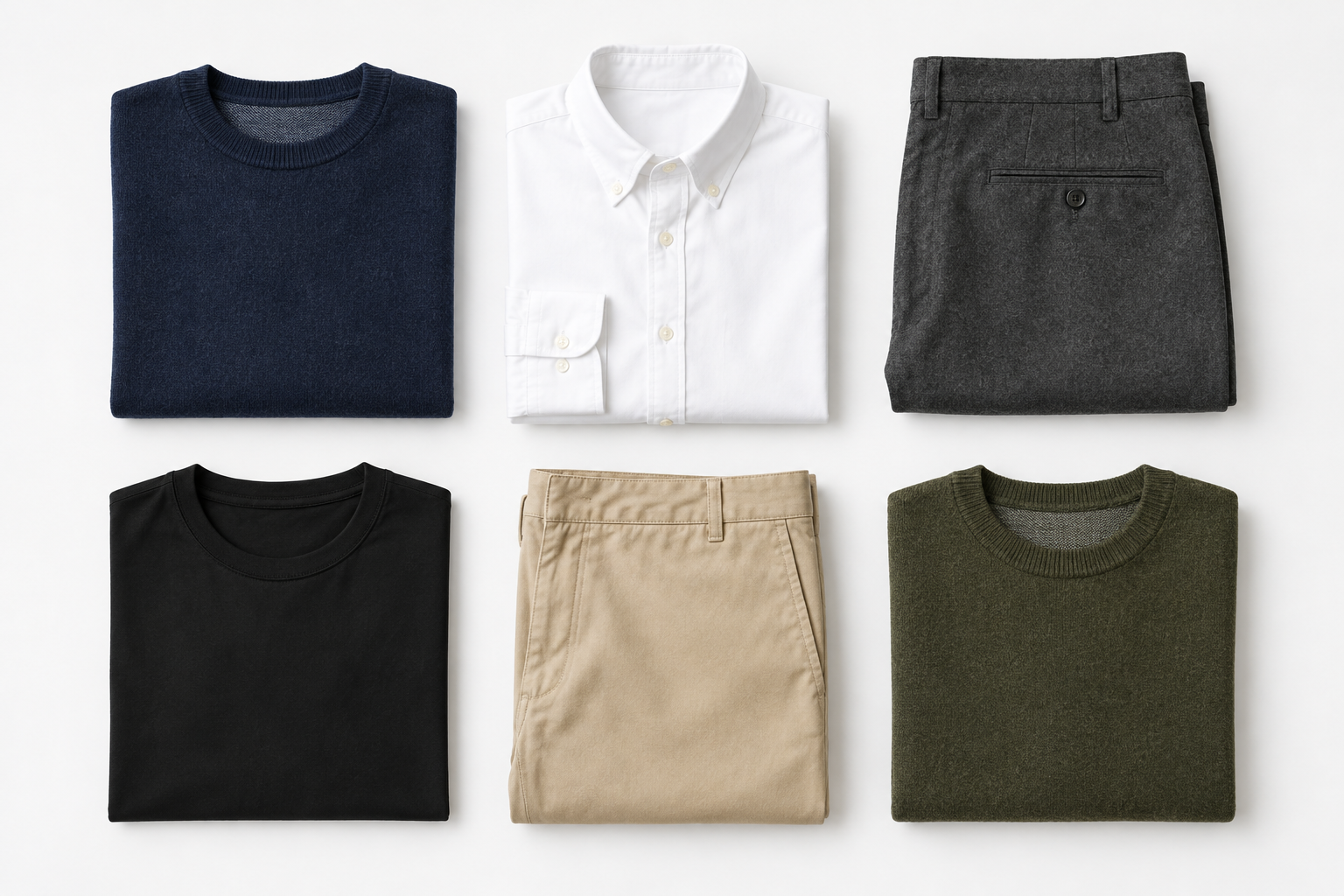
Neutral colors are those that have little color saturation and work with anything and even other neutrals. Men’s wear operates on 6 such colors: navy, grey ranging from light to charcoal, black, white, beige, and its darker cousin called tan, and olive.
This is the reason why these 6 colors are responsible for doing all the hard work since none will ever clash with another color. Your navy pants will go well with a white shirt, a grey sweater, and a black jacket without you having to make any decisions at all.
The same applies for grey flannel pants. Having an oxford shirt in white, a crewneck in navy, chinos in tan, and denim in indigo means having multiple outfit combinations than what numbers would suggest.
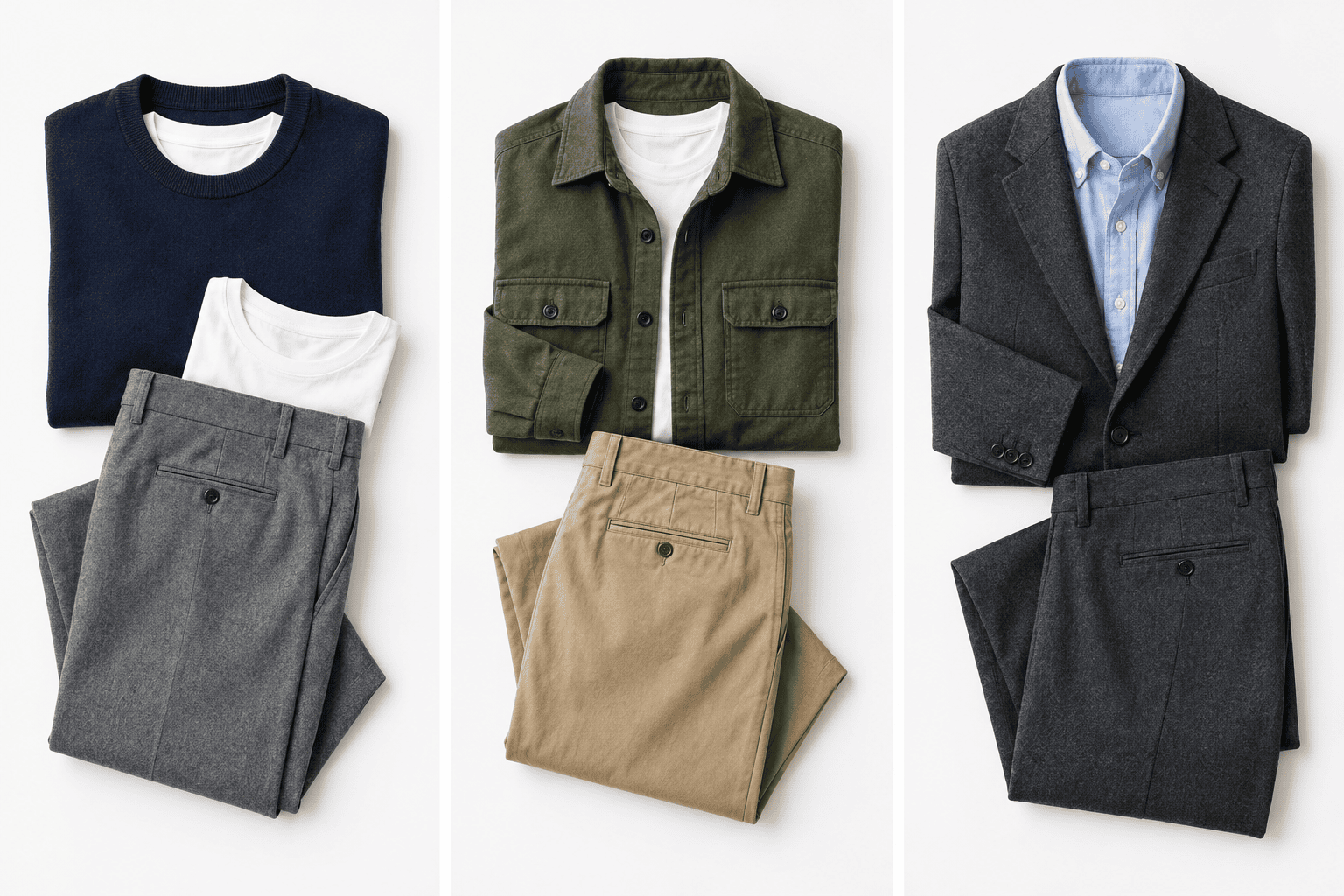
A tip on navy blue: it reads softer than black in daylight, particularly against your face, which explains why it forms the neutral backdrop for much men’s clothing around the collar. Uniqlo and J.Crew offer solid oxford button-downs and merino crew necks in this range of colors each season – always an option in finding your neutrals.
Here’s a caution: not all earth tones qualify as neutrals. Tones such as rust, mustard and burgundy appear as part of the earth family, but act as accent colors, not base colors.
These are the reasons why you can put together an effective capsule wardrobe: a small collection of clothes designed in such a way that everything goes with everything else. Our capsule wardrobe guide also uses the same math to form a complete wardrobe of 30 pieces of clothing.
When you think about your next clothes purchase: put your funds in a neutral gap before any accent.
The 2+1 Rule: How to Add Accent Colors Safely
Once your neutral base is locked in, apply the working formula: 2 neutrals + 1 accent color.
You can wear a grey crewneck, white tee, and navy trousers with a forest green beanie, rust overshirt, or burgundy scarf and look completely put together. That single colored item becomes the focal point your eye naturally lands on.
Color temperature matters more than the color wheel. Warm colors naturally harmonize with other warm colors, and cool colors belong with cool colors. Clashes happen when you mix temperatures, like throwing a warm rust overshirt on top of a cool grey and blue base.
The 6 neutrals, their temperature families, and the accents that sit safest on each:
| Neutral | Temperature | Safest accents | Easy pairings |
|---|---|---|---|
| Navy | Cool | Burgundy, forest green, mustard | White, grey, tan |
| Grey, light to charcoal | Cool | Burgundy, emerald, rust | White, black, navy |
| Black | Cool | White, grey, 1 bold accent | Grey, white |
| White | Neutral | Everything works | All 5 other neutrals |
| Beige and tan | Warm | Olive, rust, cream | Navy, olive, brown |
| Olive | Warm | Mustard, rust, burgundy | Tan, white, navy |
According to Derek Guy’s essay ‘Wardrobe Color’ for MR PORTER, it is better to keep our staples within neutral tones and use only 1 unconventional color as an accent.
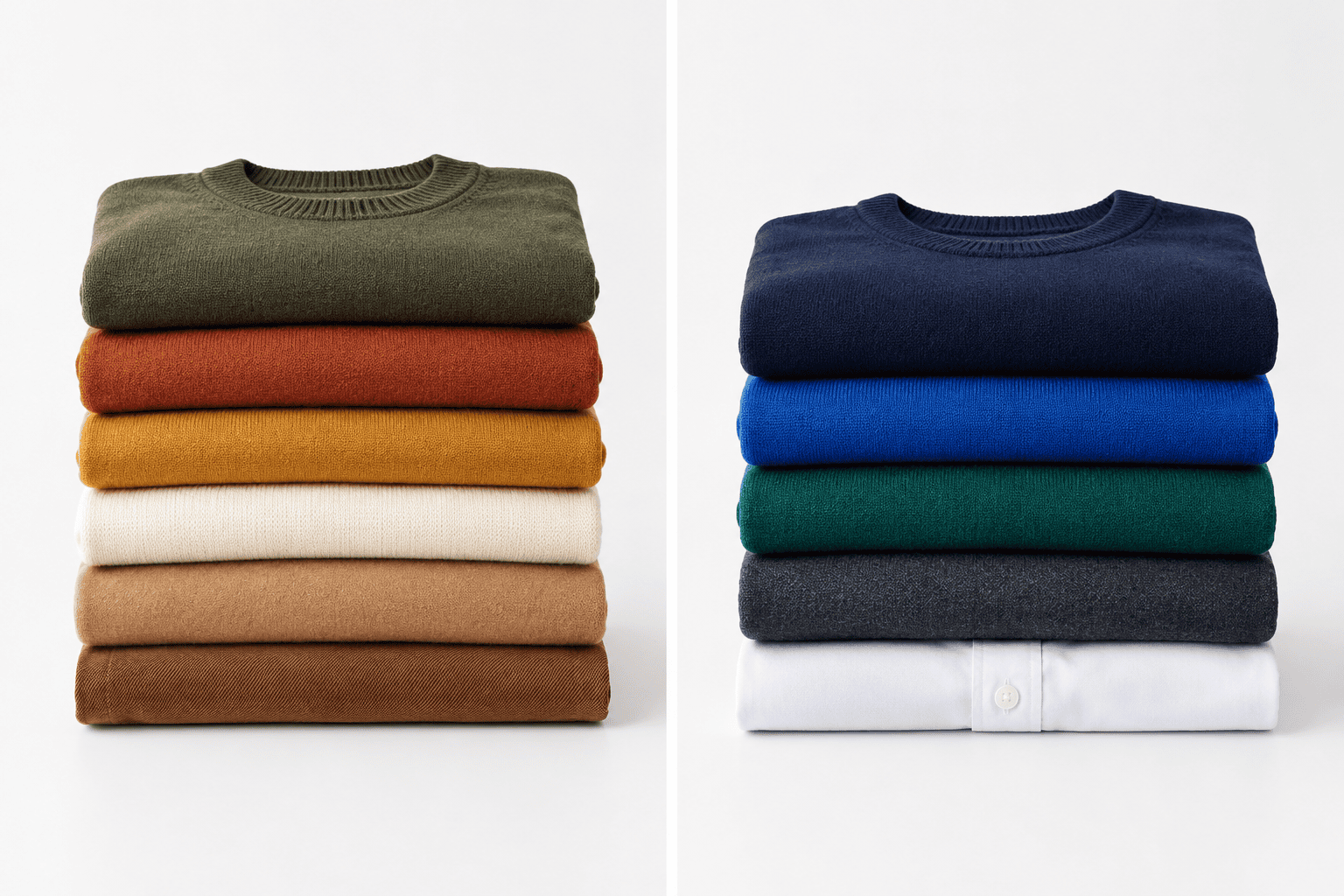
The Daylight Check: Before walking out the door, lay your full outfit on the bed—shirt to shoes—by a window in morning light. Indoor bulbs cast a yellow glow that hides color clashes until you step outside.
How to Match Clothes Colors for Men: 5 Combinations That Always Work
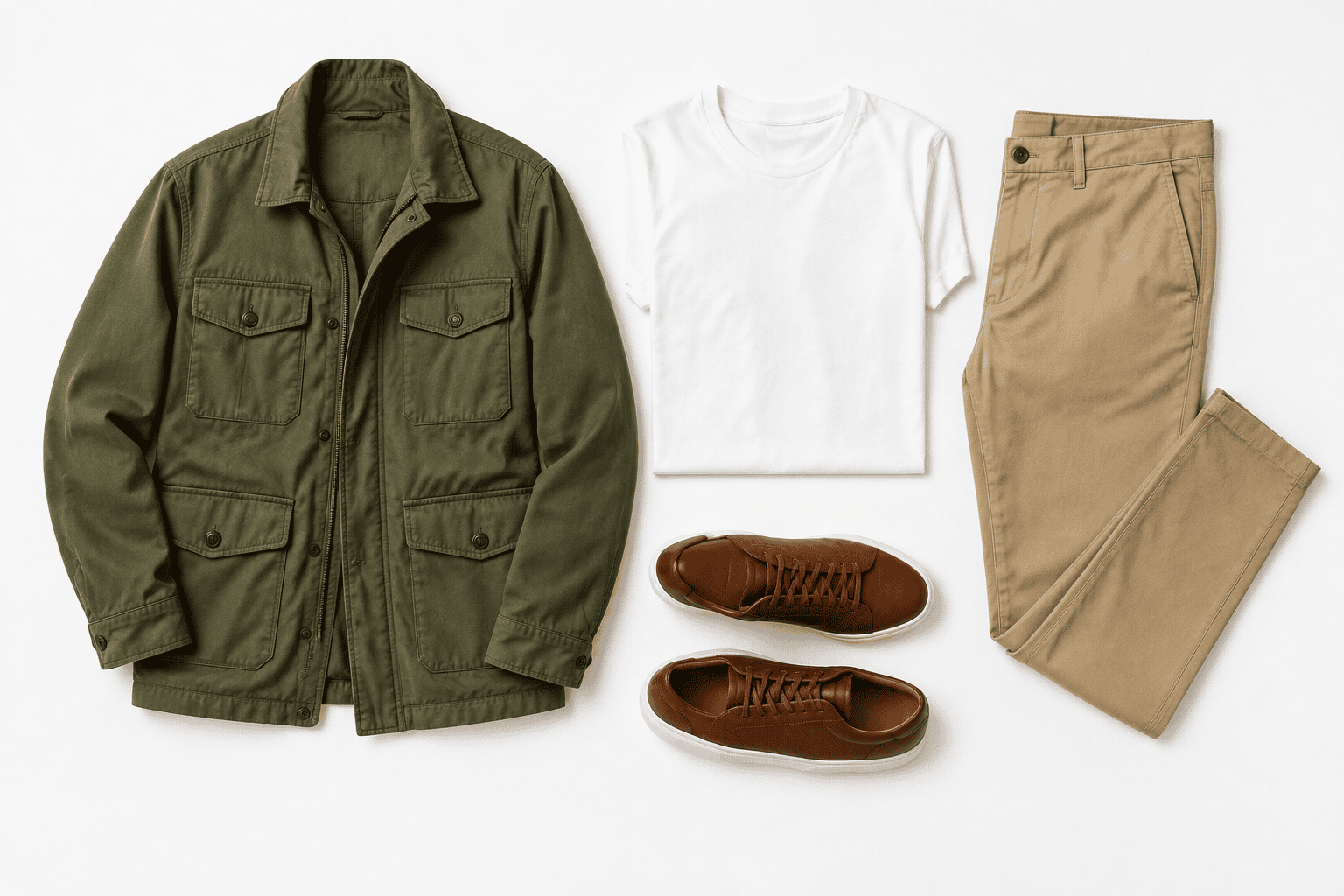

Each of these is a full outfit formula built from ordinary pieces, the kind already covered in the men’s wardrobe essentials guide. None of them needs a special purchase.
- Navy, white and grey. White oxford shirt, navy crewneck over it, grey trousers. The safest smart-casual outfit in menswear, and it survives every dress code short of a suit. Roll the oxford’s cuffs once over the sweater sleeves and the whole thing looks deliberate.
- Olive, tan and white. Olive field or overshirt jacket, white tee, tan chinos. The earthy version of the formula above, and the one that flatters warm skin tones most.
- Charcoal, light blue and black. Light blue shirt, charcoal trousers or blazer, black shoes and belt. This is the backbone of office dressing, and proportions matter more here than color, as the business casual guide for shorter men gets into.
- Brown, cream and navy. Brown knit or suede jacket, cream tee or oxford, dark navy denim. Brown over navy is one of the oldest combinations in tailoring, and it reads expensive at any budget.
- Black, grey and white. Black jacket or overshirt, grey sweatshirt or knit, white tee and white sneakers. The streetwear end of the system, and the most forgiving palette for experimenting with silhouette.
Notice what none of these includes: a second accent. Each outfit picks 1 temperature family and stays inside it.
Match the Color to Your Skin First

Every season has its color du jour, and every season men purchase it and wonder why they look awful in it. Prior to choosing a trend color, and prior to choosing the right color for your personal style, choose the color for your skin. What looks beautiful in another person’s photograph may look awful on you, and the problem lies in undertones and not the color.
Undertone is a warm or cool hue underlying your skin surface. A quick and easy test that takes about 10 seconds is looking at the veins in your wrist. If your veins look blue and purple then your undertone is cool, if you see green veins then your undertone is warm. If your veins do not allow to say whether they are blue, purple or green, it means your skin undertone is neutral and wears all colors nicely.
If you have warm undertone, choose earth colors for yourself: olive, rusty, mustard, creamy, camel, brown. If you have cool undertone choose crisp colors: dark blue, emerald, charcoal, pure white, navy. Darker skin tones can bear high contrast well, so vivid colors near your face would work instead of overpowering your appearance. There is only one universal rule of matching – contrast: the more contrasting hair, skin and clothes are in your outfit, the more purposeful it appears.
If a trend color conflicts with your undertone, try keeping it under your belt. Mustard trousers become more wearable than a mustard crewneck for your cool-toned skin because a contrast occurs either near your face or not at all.
Here is your challenge this week: choose two t-shirts of similar shades, one of cream color and one of pure white color, and hold them under your chin to see how each of these looks. The one that makes your skin look healthier – is your family.
Shoes and Belts: The 2 Rules Left Standing


Many old color rules are now passé. 2 still earn their keep.
Matching colors like brown and brown and black and black. Your shoes and belt don’t need to match exactly, just stay within the same family. Dark brown derbies with a tan belt work, but black shoes and a brown belt do not.
The contrast between black shoes and earth tones feels awkward; an outfit of olive and tan with black shoes feels like a split at the ankle. Brown shoes – from tan to chocolate – suit all possible warm colors. That is one reason your first pair of dress shoes needs to be brown.
One interesting test: brown leather changes radically in different lighting inside, and two browns that matched in the store can look wildly different outdoors. Test your belt in sunshine against your shoes once, and you won’t wonder about it again.
There is an exception. A clean white sneaker will function like a neutral in any situation described in this article. Now you know how to match belts and shoes in your outfits. 🙂
What are the worst color combos in menswear?
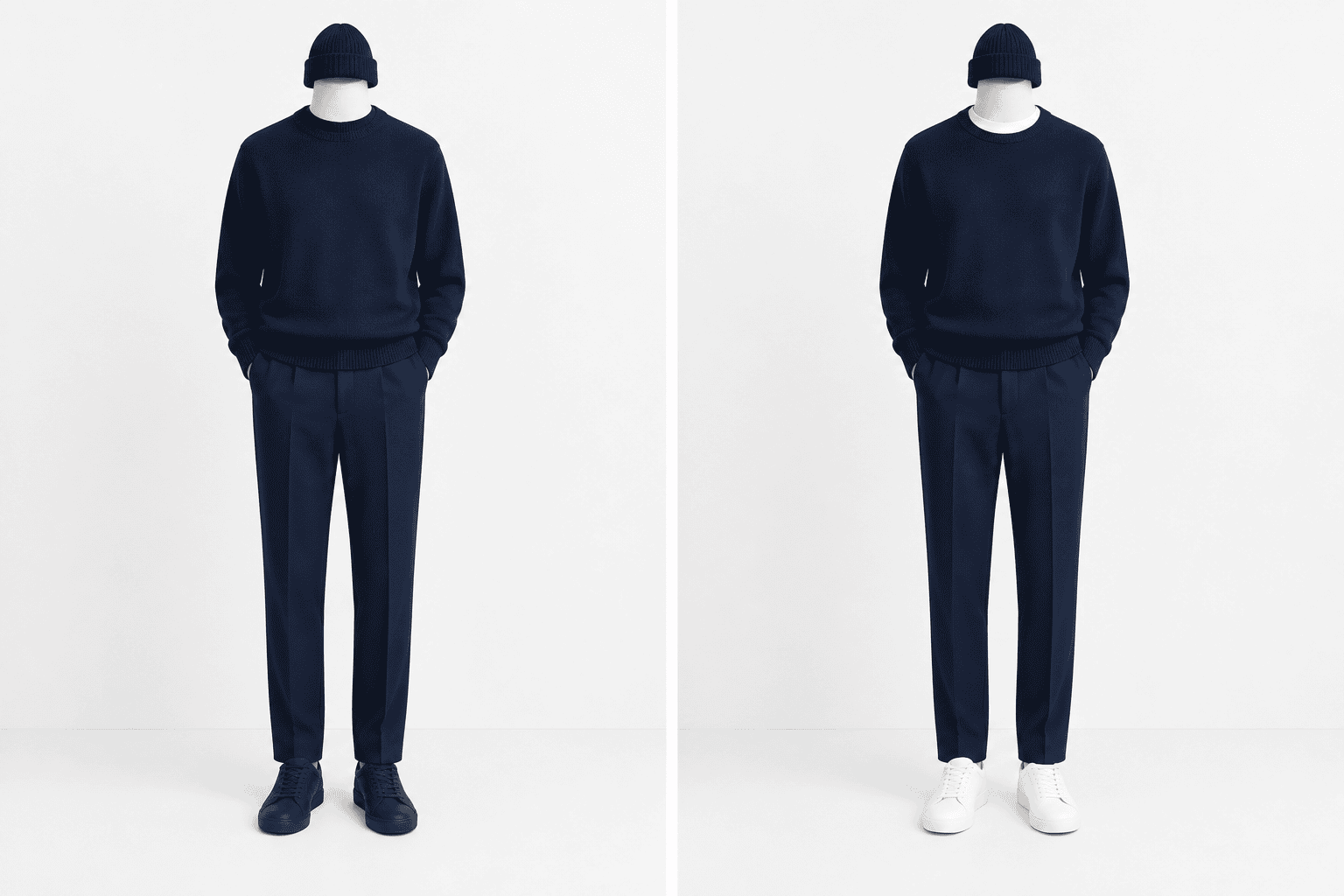
You are making a few mistakes that cause every outfit of yours to fail or look off, and they are almost always 1 of these 4:
- Matching everything exactly. Navy sweater, navy trousers, navy beanie and navy sneakers reads as a uniform instead of an outfit. If the outfit looks like something a character would wear rather than a person, it fails the costume test.
- Running 2 statement colors at full volume. Your eye needs a place to rest. 1 accent per outfit, everything else neutral.
- Clashing temperatures. A warm rust layer over a cool grey and blue base argues with itself. Stay inside 1 temperature family per outfit.
- Forgetting the shoes count as a color. A loud sneaker becomes your outfit’s 1 accent whether you meant it or not.
The fixes are all small. Break a run of 1 color with a single contrast, even just a white tee at the collar. Demote the second accent to something quiet. Swap the shoe. You will rarely need to change more than 1 piece, which is the point of building on neutrals in the first place.
The 30-second summary
That is really all there is to how to match clothes colors for men:
- Build every outfit on 2 neutrals from the 6: navy, grey, black, white, beige or tan, and olive.
- Add at most 1 accent color, and keep it inside 1 temperature family.
- Match shoes and belt by family: brown with brown, black with black. White sneakers are exempt.
- Lay the full outfit out and check it in daylight before you leave.
FAQs
How many colors should a man’s outfit have?
2 neutrals and 1 accent covers almost every situation. 3 distinct colors is the practical ceiling, and the third should be quiet, like a second neutral. Past that, the outfit starts competing with you.
Do shoes have to match the belt?
Not exactly anymore. Keep them in the same color family, brown with brown, black with black, and let the finishes differ. Sneakers are exempt entirely.
What colors go with everything?
Navy, grey, black, white, beige and olive. These 6 neutrals pair with each other and with nearly every accent color, which is why they make up the base of the system. Build your closet around them and matching stops being a daily question.
Can you wear black and navy together?
Yes. Tailoring has done it for decades, and you can too, with 1 precaution: keep the 2 clearly different in tone or texture. A navy knit over black jeans works because the knit reads lighter and softer. 2 near-identical darks next to each other look like you got dressed in the dark and grabbed the wrong piece. When in doubt, put a white or grey layer between them and the question settles itself.
Can men wear bright colors?
Wear 1 at a time. A scarlet beanie on a grey and navy outfit reads as style. That same beanie with a bright tee and colored sneakers reads as noise.
Which 2 colors should never be worn together?
Honestly, no pair is banned. Loudness is the real variable; the colors themselves are rarely the problem. Complementary opposites like red and green or orange and blue shout when both show up at equal strength, but either pair works when 1 color dominates and the other stays small, think a green jacket with a thin red stripe in the scarf. Saturation and proportion cause clashes. The colors themselves are innocent until you crank the volume on both.
The One-Evening Version
This whole system for how to match clothes colors for men reduces to 1 evening of work. Pull 2 neutrals and 1 colored piece from your closet, lay the full outfit on the bed with shoes and belt included, and look at it in morning daylight. If it holds together there, it will hold together anywhere.
Pingback: What to Wear on a Dinner Date: A Men's Style Guide
Pingback: How to Dress Like a Tech CEO: The 3 Uniforms That Work