The six garments the style actually runs on, the fit that makes them read as emo, and where emo sits against goth, punk and scene.
By Ghoul, FashionXD. Last updated August 14, 2026.
Independent editorial. No affiliate links. No sponsored placements.
Emo fashion for men runs on six pieces: slim black denim, a fitted band tee, a studded belt, low top canvas sneakers, a dark layer that follows the body, and dark hair worn long in front. The style came out of 1980s Washington hardcore and took its recognizable form in the mid-2000s.
What is emo fashion?
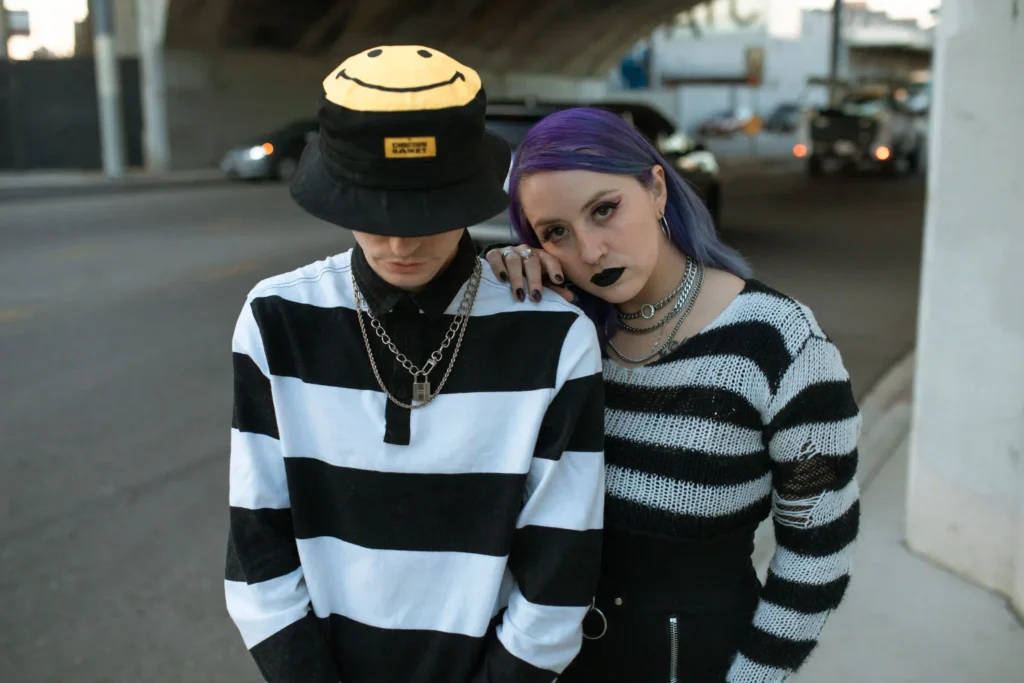
Emo fashion is the dress code of the emo music subculture, built on close fitting dark clothing, band merchandise, and visible metal hardware. Emo sits inside the wider family of dark and subcultural menswear, alongside goth, punk, grunge and scene, and it is the branch most tightly bound to a specific decade of music.
Most men get the silhouette wrong before they get anything else wrong. Emo runs narrow in the leg, close through the chest and shoulder, and carries almost no drape anywhere on the body. Put the same black cotton on a man in a relaxed tee and straight jeans and it reads as plain dark clothing. The cut signals the style before the color does.
The rest sits in the hardware. A studded belt, a stack of rubber wristbands and a canvas bag covered in pins were all standard and all cheap. Placement carries more weight than volume. Emo hardware clusters at four points on a man: the hip, where the belt sits low and stays visible under the tee; the wrist, where bands and a cuff stack against the sleeve; the bag, which takes the pins, patches and keychains; and the neck, where a single chain or a plain leather cord ends the run. Add a fifth point and the outfit starts reading as punk, which spreads its hardware across the whole body on purpose.
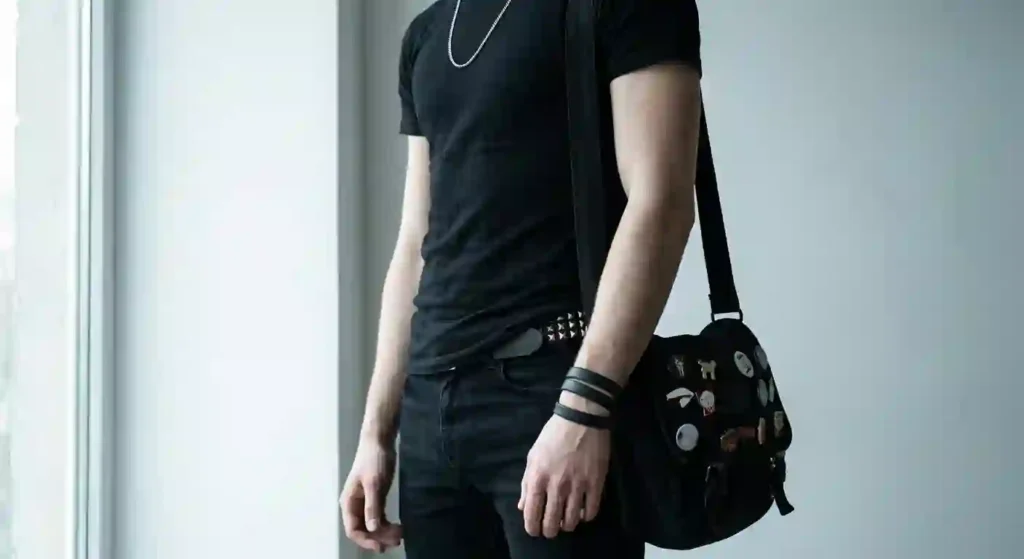
The clothes were designed to be inexpensive. The look was popularized in mall retail and thrift shops in the mid-2000s, and therefore doesn’t have a luxury tier or a “heritage” price point. Luxury houses now sell the silhouette at prices no one in the original scene could reach, and the same things get stripped out on the way up: the hardware, the band, and the fact that it cost almost nothing.
Where did emo fashion come from?
Emo began as music, in Washington, D.C., in the mid-1980s. Britannica records it as a subgenre of punk rock launched by Guy Picciotto and his band Rites of Spring, who moved away from a punk scene that favored attitude over substance and turned the lyrics toward personal pain. Britannica also notes that fans of the period shortened the confessional style to emocore. The Britannica entry on emo carries the full account.
The 1985 era in D.C. called Revolution Summer was the time when two bands were most associated: Rites of Spring and Embrace (which featured Minor Threat’s Ian MacKaye). Both have denied being emo. By 1986, most of the D.C. bands in the group had split up.
None of the men playing those songs looked like the emo stereotype. The 1980s D.C. wardrobe ran on hardcore basics: work pants, plain tees, low skate shoes. Dressing normally worked as its own refusal, since that scene read the studs and spikes of first wave punk as costume.
What happened between D.C. hardcore and the mall?
The wardrobe people picture today arrived through three separate scenes, none of them in Washington.
Through the 1990s the sound moved outward and got quieter. Cap’n Jazz, Braid, The Promise Ring and American Football built something more melodic and more technical across the Midwest, while Sunny Day Real Estate worked out of Seattle and Mineral out of Texas. The wardrobe matched the music. Chinos or plain jeans, cargo shorts in summer, a graphic band tee, and a plaid flannel or madras shirt worn open over it and almost never tucked in. The revival of the early 2010s, often called the fourth wave, brought Algernon Cadwallader, Snowing, Into It. Over It. and later Modern Baseball, and it added a beanie and pulled the whole look toward thrifted hipster territory. A man who found emo through this branch owns almost nothing on the list further down this page, which is worth saying plainly before anyone buys black denim by mistake.
Mid 1990s San Diego produced the haircut and the first real emo subculture. Heroin, Antioch Arrow and Swing Kids dyed their hair black and cut a straight fringe across the front, and people started calling the whole scene spock rock after Leonard Nimoy’s character in Star Trek. Swing Kids vocalist Justin Pearson added choppy spikes at the back of the head, and that combination became the prototype for what later got called the shotgun blast. Pearson and Aaron Montaigne of Heroin have both said the scene started dressing with intent right after watching Washington band the Nation of Ulysses play in suits.
The clothes under that hair looked nothing like 2000s emo. San Diego ran clean cut and closer to geek chic: button down shirts, sweater vests, cardigans, thick rimmed glasses in the Buddy Holly shape, tight jeans and Converse. A man building a nineties emo look shops from that list, not from the mall list further down.
The last piece came out of Orange County at the end of the decade. Eighteen Visions had members who studied cosmetology and worked in mall boutiques, and they dressed against the hardcore scene around them on purpose. Where that scene wore camo cargo shorts, hoodies and baseball caps, they wore tight jeans, white studded belts, collared black shirts, flat ironed hair and makeup. Atreyu and Bleeding Through moved the same way. Hardcore purists coined fashioncore as an insult for it, and the label stuck to any heavy band that looked like it cared how it looked. By 2004 the style had hardened into something Hot Topic could stock, and every visual signature men now read as emo was already assembled, roughly five years before the mainstream saw any of it.
Then Jimmy Eat World reached radio with “The Middle” and the labels went looking for more. My Chemical Romance and Good Charlotte carried the sound to a much larger audience and brought goth and death rock references with them, pulled from The Misfits, The Cure and Siouxsie and the Banshees. Black went from one option to the default, and it spread past the clothes to the eyes and the nails.
The four emo wardrobes, by era
Emo does not have one wardrobe. It has four, and they barely overlap. Most men arrive at this page wanting the fourth without knowing the other three exist.
| Scene and decade | What men wore | Hair | Shoes |
|---|---|---|---|
| Washington, D.C. hardcore, mid 1980s | Work pants, plain tees, no band branding | Short, unstyled | Low skate shoes |
| Midwest and adjacent scenes, 1990s | Chinos or plain jeans, graphic band tee, flannel worn open and untucked | Short, unstyled | Converse or Vans |
| San Diego, mid 1990s | Button down shirts, sweater vests, cardigans, thick rimmed glasses, tight jeans | Black dye, straight fringe, choppy spikes at the back | Converse |
| Orange County into mall retail, 2000s | Skinny black jeans, fitted band tee, studded belt in black or white, stacked wristbands | Flat ironed fringe swept across one eye | Converse or Vans |
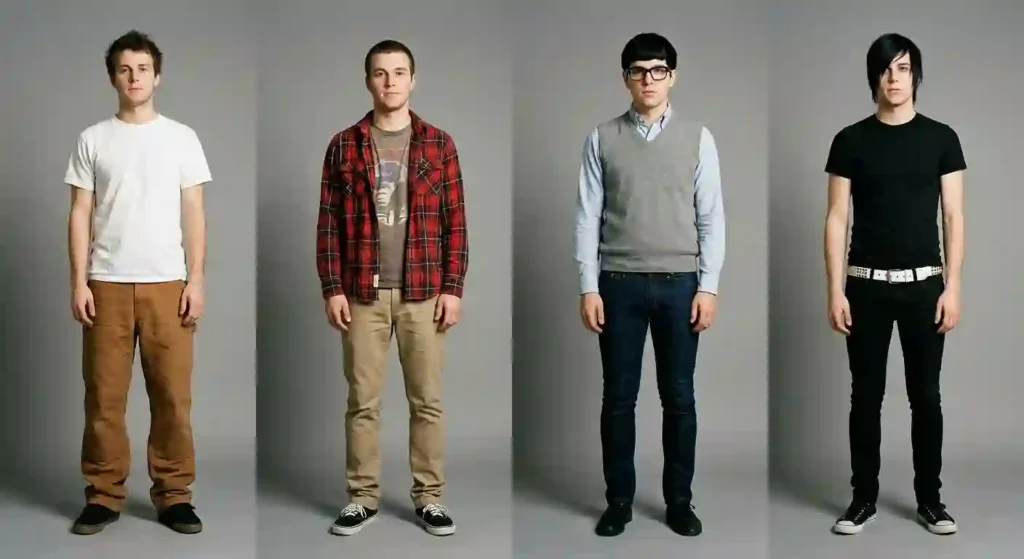
That divide has a practical result. A man who follows the lineage of the sound ends up with a different wardrobe than a man who wants the look that reached the mall, and only the second version comes with a fixed set of garments. The rest of this page covers the second version, since that is the one people picture and the one you can buy as a list.
Emo, goth, punk and scene at a glance
Four subcultures get collapsed into one by people outside all four. The table below separates them on the details that change what you buy.
| Subculture | Origin scene and decade | Core men’s silhouette | Palette | Footwear |
|---|---|---|---|---|
| Emo | Washington, D.C. hardcore, mid-1980s. Mainstream wave mid-2000s | Fitted band tee, slim black denim, studded belt worn visibly | Black with red or white accents | Low top canvas sneakers |
| Goth | UK post-punk, late 1970s into the early 1980s | Long coat, high collar, velvet and mesh layers, silver jewelry | Black with deep jewel tones | Heavy boots |
| Punk | London and New York, mid-1970s | Leather biker jacket, ripped or tartan trousers, studs and safety pins | Black, raw denim, red tartan | Combat boots |
| Scene | United States, offshoot of emo, mid-2000s | Slim jeans, bright graphic tee, stacked accessories | Neon layered over black | Skate shoes and high top sneakers |
Emo and goth separate on volume, and they get their own section further down.
Emo and punk separate on distance. Punk dresses to be read from across the street through safety pins, tartan and hand painted band names. Emo pulls the hardware in close and holds it to a belt and a wrist, so the details only land at conversation range. Punk also runs loose in the leg, wears boots, and treats damage as part of the garment. Emo keeps the leg narrow and the canvas clean.
Emo and grunge are both in the same price range, and there’s no fit overlap between the two. Grunge was from Seattle and wore loose, warm, secondhand clothes. It’s also covered in full in the FashionXD guide to grunge for men.
How to dress emo?
Six pieces carry the outfit, and every one of them depends on getting the denim right first.
Slim black denim. The cut should run close up through the thigh, taper to a narrow leg opening and be broken short or slightly stacked over the shoe. Flat black holds that leg line longer than any washed or faded denim. Avoid heavy whiskering and contrast stitching as both compete with the flat surface the rest of the outfit relies on. If you want the silhouette without the 2000s tightness, a slim taper reads identically from across a room and lets you sit down.
A fitted band tee. For emo tees, the shoulder seam sits on the shoulder point, not down the arm, and the hem ends just above the hip. Keep prints small to medium, since oversized or heavily detailed graphics push the outfit toward streetwear.
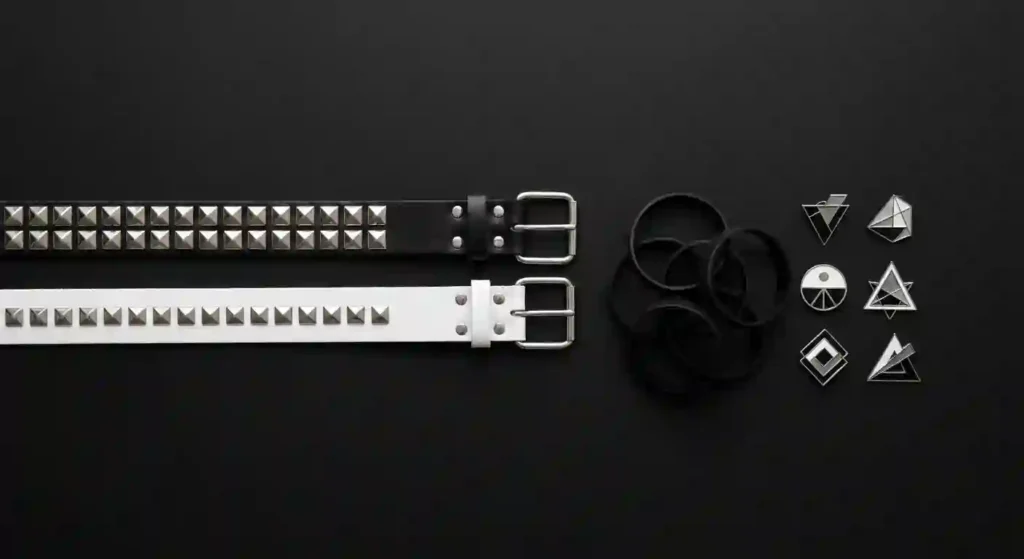
A studded belt. Worn openly, over the hips or on the hip not the natural waist. Classic belts feature one to three rows of pyramid studs on black leather. The white studded belt is the other correct answer and reads as more specifically mid 2000s, since it came out of the Orange County scene above before it reached every mall in America. Skip belts with four or more rows of studs, which read as costume on most men.
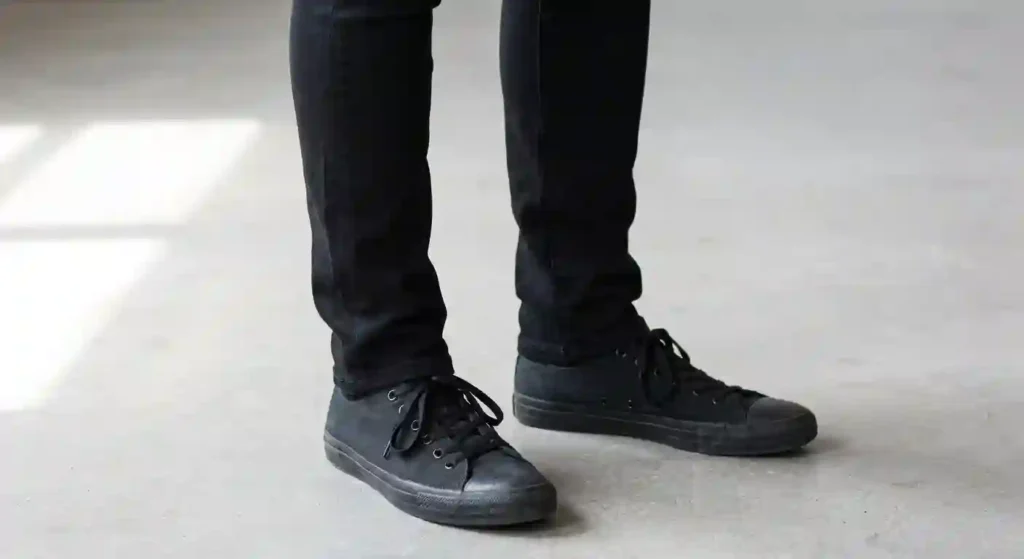
Low top canvas sneakers. As of August 2026, Converse’s Chuck T All Star Canvas low top is $60.00, the Chuck T Canvas high top is $65.00 and the Chuck 70 Canvas high top is $95.00. Converse states on its own product page that the style runs large and to order a half size down, which is the single most common sizing error men make on this shoe. Sizing and current colorways are on the Chuck Taylor All Star Canvas page. Skate shoes from Vans sit in the same slot and were equally standard in the 2000s.
A layer that follows the body. A slim black zip hoodie, a thin cardigan or a fitted denim jacket. Sleeves should end at the wrist bone, and nothing on the layer hangs loose.
Dark hair with length in front. The 2000s version was straightened flat, cut heavier on one side and worn across one eye. A shorter textured cut with a longer front section gets most of the read for far less maintenance. FashionXD will cover emo hair properly in a dedicated piece later, since the cut, the products and the grow out are a subject of their own.
Almost none of this hardware was bought finished. Studs push through leather with a screwdriver and a scrap of wood behind the belt, and a plain black belt plus a bag of pyramid studs still costs less than a finished one. Safety pins attach to anything with a seam. Patches sew or iron onto a canvas bag, a hoodie sleeve or the back of a denim jacket, and pins cover a strap in an afternoon. The subculture built its hardware this way because the people in it could not afford otherwise, and a belt you studded yourself sits differently to anyone who recognizes the work.
How to build an emo outfit, step by step
Most men buy in excitement order. The belt and the wristbands are cheap and they feel like the identity, so those land first, and then the denim arrives wrong and none of it works together. Build in dependency order instead. Every step below limits the one after it.
- Black denim. Slim through the thigh, tapered at the ankle, flat black with no fading. Nothing you buy above the knee fixes a wrong leg line. Around $40 to $80 new at mainstream retail.
- Low top canvas sneakers. Buy these before you decide on a hem. The shoe decides whether the denim breaks short or stacks over it, and a low profile is what keeps the leg reading narrow all the way down. Chuck Taylor All Star Canvas lists at $60.00 as of August 2026.
- Two fitted tees. One plain black, one with a small chest print. Shoulder seam on the shoulder point, hem just above the hip. Two is the minimum that lets you wear this twice a week without it turning into a uniform. Roughly $15 to $30 each.
- One layer. A slim black zip hoodie, a thin cardigan or a fitted denim jacket. Sleeves end at the wrist bone. Buy it after the tees so you can check it closes over them without pulling across the chest.
- Hardware. Belt goes on last, slung low so it peeks out under an untucked tee, then wristbands and pins from there. Cheapest step, most personal step, and the only one you can change daily. Roughly $15 to $30 for the belt and close to nothing for the rest if you build it yourself.
- Hair. Always last. Every decision above this line reverses in an afternoon. A cut takes three to six months to grow out, so wear the clothes for a few weeks and let the rest of the outfit read correctly before you commit to the fringe.
Three emo outfits that work
The starter. Black slim taper jeans, plain black fitted tee, black low top canvas sneakers, black studded belt worn visible. Nothing else. This reads correctly on a man of any age and lands under $150 new. Wear it for a month before you add anything to it.
The full mid 2000s. Black skinny jeans, fitted band tee with a small chest print, white studded belt, stacked black rubber wristbands on one arm, slim black zip hoodie left open, black and white low top canvas sneakers, hair long in front and swept across one eye. This is the version people picture when they search. It is also the version that tips into period costume past thirty unless every fit is modern.
The modern. Black slim taper jeans, fitted charcoal or black tee, fitted black denim jacket, black low top canvas sneakers, one thin silver chain, no belt hardware showing. Textured hair with length in front and no flat iron. This carries the silhouette and the palette into ordinary menswear and holds up at a bar, at a show, or in an office with a relaxed code.
What breaks an emo outfit?
Four failures cause most of the damage.
- A relaxed or straight leg. The entire silhouette hangs on a narrow leg opening, so a wider cut cancels everything above it.
- A bulky shoe. Chunky trainers and thick midsoles make the leg read bottom heavy and undo the taper.
- Hardware past four points. Hip, wrist, bag and neck is the emo distribution. A fifth point spreads it across the body, which is punk.
- Mixing eras. A flannel over skinny jeans and a studded belt pulls from two different rows of the wardrobe table above and reads as a costume built from parts.
What is the difference between emo and goth?
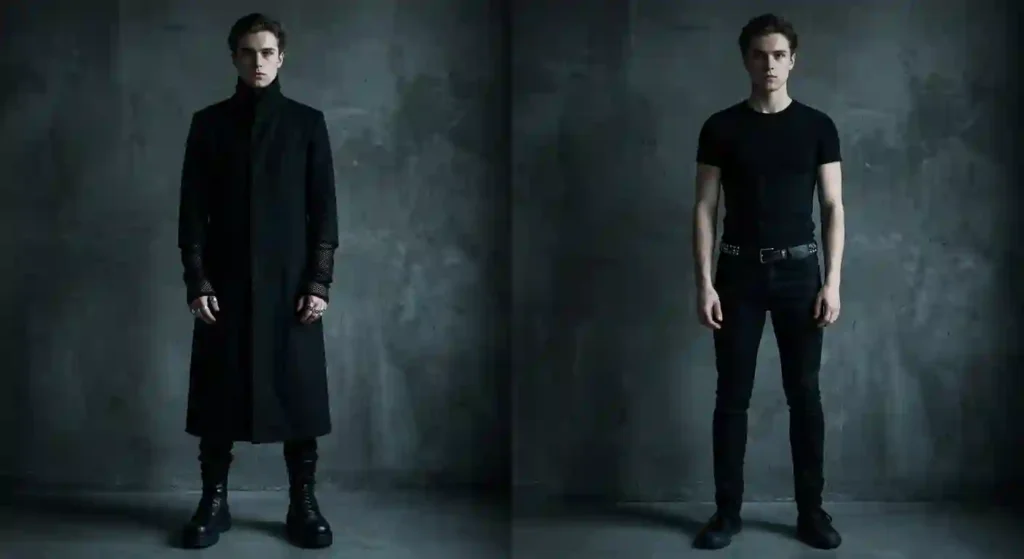
Emo and goth came out of different decades, different countries and different music, and the clothes diverged from there. Goth began as a British post-punk movement at the beginning of the 1980s, inspired by Victorian outfits, horror scenes and dark romance. Emo began in America’s hardcore scene in the mid 1980s and was inspired by skate and mall retail.
The wardrobes split on cut and texture. Goth features velvet, lace, mesh, leather, long coats, high collars, some silver or occult jewelry and heavy boots. Emo runs on cotton jersey and denim, lines held tight to the body, a studded belt and canvas sneakers.
Eyeliner and a black palette form the entire overlap, which is why people confuse the two. Men who want the theatrical, textured version of dark dressing should read the FashionXD breakdown of goth style for men, because it is a separate wardrobe with separate rules.
What scene style is, and how it differs from emo
Scene grew out of emo in the mid 2000s in the United States and spread through MySpace, cheap digital cameras and the same touring circuit. It kept the emo silhouette exactly, slim jeans and a tight graphic tee, and swapped the mood for the camera. The word started as an insult aimed at people who wore the clothes without following the bands, then stuck as the name of the branch.
Color draws the line. Emo runs black with a red or white accent. Scene runs neon over black, with hot pink, lime and electric blue landing on the graphic, the belt, the laces and the hair at once. The accessories stack too, from jelly bracelets to a checkered belt to oversized plastic sunglasses.
Men’s scene was always rarer than women’s, so a picture search skews female and hands men a distorted reference. A man building a scene outfit gets a better result carrying color through two elements than through six.
2000s emo versus the emo revival now
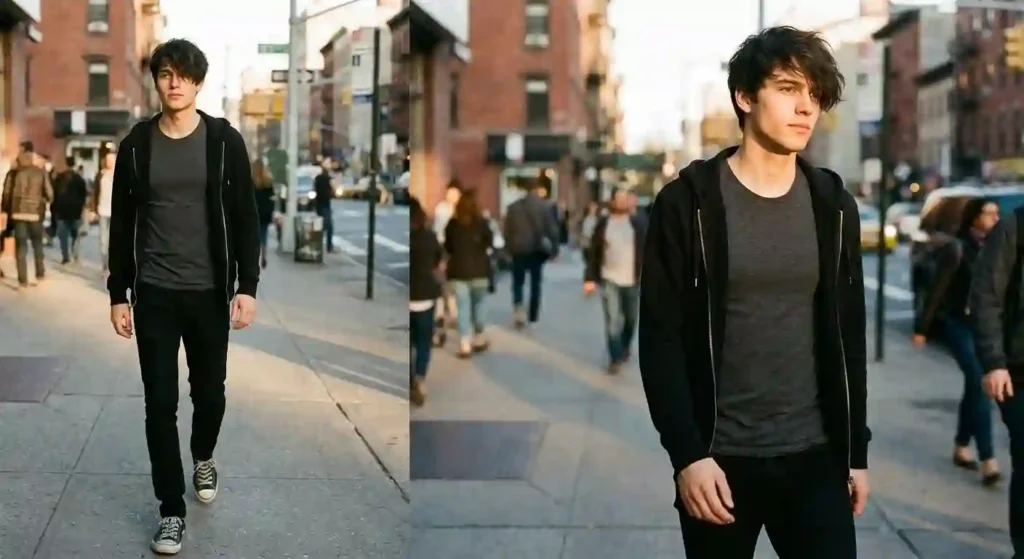
The revival is real, documented, and currently in a pause year. When We Were Young first ran in Santa Ana, California in 2017, then relaunched at the Las Vegas Festival Grounds in 2022 with My Chemical Romance and Paramore headlining. That 2022 edition sold out its first date immediately and picked up second and third dates within a week, per Variety’s January 2022 reporting. It ran every October from 2022 through 2025, with Blink-182 and Green Day in 2023, My Chemical Romance and Fall Out Boy in 2024, and Panic! at the Disco and Blink-182 in 2025.
Then it stopped. On February 27, 2026, organizers announced there would be no 2026 edition and that the festival returns to Las Vegas in October 2027, as Billboard reported. Punk Rock Bowling, Boston Calling and Hangout Fest all sat out 2026 as well, and all three have dated 2027 returns, with Boston Calling moving off Memorial Day weekend to June 4 through 6. Vans Warped Tour went the other direction and ran five stops in 2026: Washington, D.C. on June 13 and 14, Long Beach on July 25 and 26, Montreal on August 21 and 22, Mexico City on September 12 and 13, and Orlando on November 14 and 15. Warped has already dated Long Beach for July 24 and 25, 2027.
Read the clothing separately from the touring calendar. The wardrobe has been absorbed into ordinary menswear and no longer depends on a festival cycle to stay current, which is why slim black denim, band tees and canvas low tops sit in regular rotation for men who have never called themselves emo.
A pause year in the touring calendar changes nothing about the six garments above. Emo rap arrived in the mid 2010s and carried the wardrobe to a group who never bought a Warped ticket. Black slim denim, a fitted graphic tee and long hair worn over the face passed to that audience through rappers rather than through bands, which is why search interest in the clothing holds steady in years when no festival runs.
One change is worth making against the 2000s original. That version was cut tighter than anything sold at mainstream retail today, with jeans closer to a second skin than a slim fit. A modern slim or slim taper reads as emo without reading as a period costume, and that is the difference between wearing the style and reenacting it.
For where emo sits among the broader style categories available to men, FashionXD maps the full set in its guide to the main men’s style categories.
Where to start if you own none of this
Buy the denim first and wear it for two weeks with clothes you already own. If the leg line looks right, everything else costs under a hundred dollars and can be added one piece at a time. The belt, the wristbands and the pins are all cheap by design, and the hair is the only decision that takes months to reverse. Emo rewards patience in exactly one place, and that is the haircut.
Common questions about emo fashion for men
What is pastel emo?
Pastel emo swaps the black base for soft pinks, mints, lilacs and creams while keeping the emo silhouette and the emo hair shape. The cut stays slim, the tee stays fitted, and the length stays long in front. It sits closer to scene than to traditional emo in spirit and appears far more online than on the street.
Do you need eyeliner to dress emo as a man?
No. The clothing carries the style on its own, and the fit of the denim does more work than any grooming choice. Eyeliner is a mid-2000s signature and reads as a full commitment to that era. A man who wants the wardrobe without the period signal can skip it and lose nothing structural.
What is emo grunge?
Emo grunge describes a hybrid that puts grunge’s flannel, layered textures and worn denim over an emo base of black band tees and dark slim jeans. The result runs looser than emo and darker than grunge. It holds together because both subcultures were built from cheap secondhand garments, so the pieces sit together without looking assembled from two costumes.
Can you dress emo without skinny jeans?
Yes, and most men should. Skinny jeans returned to the 2026 runways as a proportion choice rather than a default, and the emo silhouette only needs a narrow leg opening, not a second skin. A slim taper gives you the same line from a distance, sits better on an adult frame, and lets you sit through a set without standing back up in pain. Straight and relaxed cuts break the look entirely, since the whole outfit is built to read narrow.
How do you dress emo without looking feminine?
The effeminate read comes from the grooming, not the garments. Eyeliner, flat ironed hair and painted nails carry the mid 2000s signal, and all three are optional. Black denim, a fitted band tee, a studded belt and canvas sneakers read as alternative menswear on their own. Keep the tee fitted rather than tight, take the layer up to a denim jacket instead of a cardigan, and the outfit lands closer to punk adjacent than to the 2006 mall version.
What do you wear to an emo night?
Black slim denim, a band tee for a band actually on the setlist, a studded belt and low top canvas sneakers. Skip anything with a heavy layer, since these events run hot and crowded. A thin zip hoodie tied at the waist covers the temperature swing without leaving you holding a coat. The pins and the wristbands do more work here than anywhere else, because everyone in the room reads them.
Can a man dress emo in his 30s or 40s?
The wardrobe scales up better than most subcultural dress because it is built from plain garments. Black denim, a fitted tee and canvas sneakers carry no age signal at all. What dates a man is the period specific grooming and the 2006 tightness. Move to a slim taper, keep the tee properly fitted at the shoulder, take the hair to a textured cut with length in front rather than a flat ironed curtain, and the look reads as a style rather than a memory.
How much does a full emo outfit cost?
Under two hundred dollars if you buy new and shop the basics. Chuck Taylor All Star Canvas low tops list at $60.00 as of August 2026, black slim denim runs forty to eighty at mainstream retail, a plain black tee is under twenty, and a studded belt is fifteen to thirty. Thrift the tee and the belt and you cut that figure roughly in half. The style was assembled by teenagers with no money, and the price ceiling has never been part of it.
What is the difference between emo and mall goth?
Mall goth ran through the same retail channel in the same decade but pulled from industrial and nu metal rather than from hardcore. It uses heavy buckled boots, wide leg or flared black pants, mesh sleeves, chain wallets and horror imagery. Emo keeps the leg narrow and the shoe flat. The overlap sits at the retail counter and the eyeliner, and nowhere else.
What is spock rock and what is a shotgun blast haircut?
Spock rock was the name attached to the mid 1990s San Diego emo scene, taken from the straight black fringe those bands cut across the forehead. The shotgun blast came from the same scene: Swing Kids vocalist Justin Pearson wore the straight fringe with choppy spikes protruding from the back of the head, and that combination became the direct ancestor of the 2000s emo cut. Both terms predate the mall version by roughly a decade.
What shoes work for emo besides Converse?
Vans slip ons and Old Skools sat in exactly the same slot through the 2000s and still do. Beyond those, look for a flat sole, a low profile and canvas or plain black leather. What breaks the outfit is bulk. Chunky trainers, running shoes and anything with a thick midsole fight the narrow leg and make the whole silhouette read bottom heavy. Boots push the look toward punk or goth rather than emo.
How do you dress emo in hot weather?
Drop the layer and let the tee and the denim carry it. Black cotton in a lighter weight beats a black hoodie every time, and a short sleeve button down worn open over the tee gives you the layered read without the heat. Black denim in a lighter weight jean holds the leg line fine. The hardware costs you nothing in temperature, so the belt, the wristbands and the pins do the identifying work in summer.
Does emo work for bigger or taller men?
It works, with two adjustments. Taller men should size the tee for length before width, since a standard body will ride up above the belt and break the line the outfit depends on. Broader men should take the denim to a slim taper rather than a true skinny, which keeps a narrow ankle without pulling across the thigh. The belt sits lower on the hips in both cases. The silhouette is about a narrow leg opening and a defined shoulder, and neither of those requires being thin.
Sources checked for this piece: Britannica on emo’s origins, Variety’s January 2022 reporting on When We Were Young, Billboard on the 2026 hiatus and the 2026 Warped Tour dates, and Converse’s own product pages for current pricing and sizing. Band history for the San Diego and Orange County scenes drawn from published interviews with the musicians involved. Prices verified August 2026.