
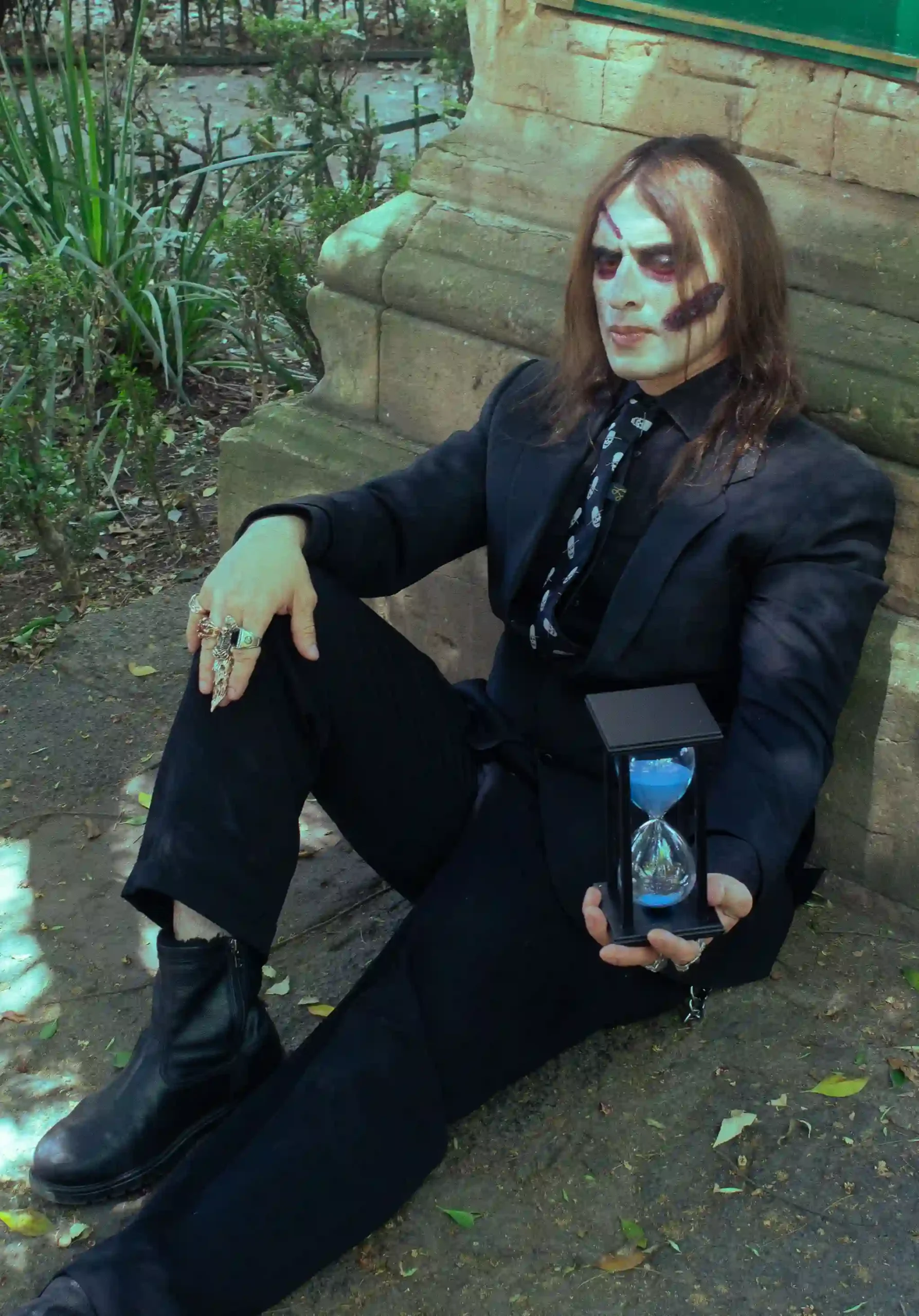
Goth Fashion for Men: The Sub-Genres, the Wardrobe, and How to Wear It
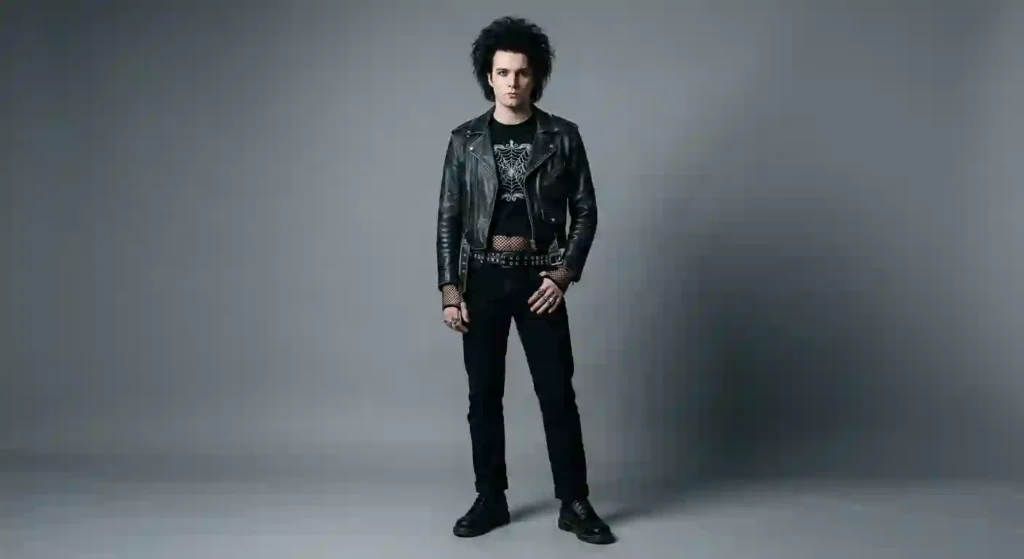
9 goth sub-genres for men, the garments that define each one, and how to wear them to an office, through a July afternoon, and out at night. Prices are current and dated.
By FashionXD Editorial | Published July 13, 2026 | Last updated July 13, 2026
Goth fashion for men is a dark way of dressing built on black clothing, lean silhouettes, heavy footwear, and metal hardware. It splits into named sub-genres, including trad goth, deathrock, victorian goth, mall goth, cyber goth, nu goth and corporate goth, each with its own garments, palette and level of visibility. Goth fashion men styles fall under the broader types of men’s fashion styles.
Most men who search for this land on a store category page or a guide written for women, take the same three cues from it, and end up in a black t-shirt, black jeans and a silver chain. That outfit is fine. It is also the reason so many men decide goth “doesn’t suit them” and quit. The sub-genre they wanted had a specific silhouette, a specific fabric and a specific shoe, and nobody told them which one. If you have no clue about goth fashion for men, then this is your guide. We’ll be answering most of your burning questions about goth fashion for men, including how to dress goth as a man, the subtleties in goth aesthetics, and more.
Table of Contents
- What is goth fashion for men?
- Where it came from: 1979 to 1986
- The nine goth sub-genres, compared
- How to dress goth as a man: the starting sequence
- The core goth wardrobe, piece by piece
- Corporate goth: goth that survives a dress code
- Casual goth and summer goth: black in daylight and in heat
- Hip hop goth: the crossover look
- Goth, emo and grunge are three different things
- 80s goth versus goth now
- What it costs to start
- Questions men ask about goth style
What is goth fashion for men?
Goth menswear runs on five levers, and every sub-genre is a different setting of the same five.
Color. Black dominates the goth look and one secondary color does the accent work. Traditional goths love deep red and purple accents. Victorian goths prefer jet black and silver. Pastel goths prefer lavender and mint accents. Writer Ted Polhemus, in Streetstyle (Thames and Hudson, 1994) described goth as “black velvets, lace, fishnets and leather tinged with scarlet or purple.” This description of goth fashion still holds true thirty years later.
Silhouette. Goth fashion relies heavily on vertical lines and deliberate proportions. Most sub-genres favor a lean, elongated silhouette composed of slim or straight trousers paired with heavy, layered, or longline tops. However, proportions shift dramatically by sub-genre. For instance, mall goths reject the lean line entirely in favor of bottom-heavy volume, utilizing wide-legged bondage pants to contrast with fitted band t-shirts.
Texture. Because black is the dominant color, different fabrics must do the heavy lifting to keep an outfit from looking flat. Mixing textures is essential. Velvet, leather, mesh, lace, and heavyweight cotton all reflect light differently, allowing a monochrome outfit to retain depth and visual interest without relying on color.
Hardware. Silver accessories define goth fashion statements. Silver jewelry and accessories work much better in goth fashion than gold accessories. Hardware choices include buckles, D-rings, studs, chains, rings and even an ankh or a cross pendant. This accessory choice will define whether an outfit transforms from dark to goth fashion or shows up as costume attire.
Contrast. The goth fashion aesthetic needs to have a contrast between light and dark colors in the outfit. Examples of such contrast include pale skin tones with dark outfits, silver accessories against a dark outfit and a white color in the outfit such as a shirt cuff or accent color. An all black outfit with no light or dark contrast will tend to flatten into a black shadow on the wearer.
That 5-lever model is the practical layer beneath everything below. If you want the wider map of where goth sits among other men’s style categories, start with the full map of men’s style categories, then come back.
Where it came from: 1979 to 1986

Gothic style emerged from British post-punk between 1979 and 1986. Goth is one of the few subculture fashion styles for men to have a starting date. The German band Bauhaus recorded their song “Bela Lugosi’s Dead” at Beck Studios in Wellingborough on January 26, 1979, and released the song on August 6, 1979.
Uncut’s oral history of the single describes it as the goth prototype while making clear the band never wanted the label. Guitarist Daniel Ash told the magazine the term “was a bit of an insult in England back then.”
The clothes were codified in a Soho basement. The Batcave was a club night that played around London’s Soho from 1982 to 1986 and was started by Olli Wisdom and Jon Klein, with Wisdom’s band Specimen headlining the shows. Far Out Magazine’s account of the club records cobwebbed ceilings, black bin liners on the walls and a real coffin at the entrance.
It also records a detail most goth fashion for men style guides leave out about Batcave fashion: that it was do-it-yourself because goth clothing was not on the high street and what was available was expensive. The 1980s goth wardrobe was homemade for the simple fact that there was clothing to buy in the first place. That is why goth clothing looked the way that it did.
Two regional scenes fed into each other. The trad goth scene includes elements of the British Batcave with its creepers, winklepickers and backcombed hair. Deathrock, from the American scene, originated in the early punk scene in Los Angeles but developed more of a do-it-yourself scene to Batcave influence when the two regional scenes mixed together.
The 9 goth sub-genres, compared
Goth for men is a set of nine nameable sub-genres, each with a different silhouette, a different shoe and a different place it works. The table compares them on the terms that decide whether an outfit lands.
| Sub-genre | Defining men’s silhouette | Key garments | Footwear | Palette beyond black | Where it works | What drives the cost |
|---|---|---|---|---|---|---|
| Trad goth | Lean legs, layered top, high contrast | Band tee, torn mesh layer, black jeans or leather trousers, cropped leather jacket | Creepers, winklepickers, Dr. Martens 1460 | Deep red, purple | Club nights, gigs, evening | Footwear |
| Deathrock | Lean, torn, deliberately rough | Horror or band tee, fishnet under-layer, slim black jeans, studded belt, patched leather jacket | Combat boots | White face makeup, red | Gigs, clubs | Cheapest entry, mostly DIY |
| Romantic goth | Soft volume up top, narrow leg | Poet or ruffled shirt, velvet jacket, brocade waistcoat, black trousers | Winklepickers, polished Chelsea boots | Burgundy, plum, midnight blue | Formal evening, weddings | The velvet jacket |
| Victorian goth | Long, structured, buttoned to the throat | Frock coat, high-collar shirt, cravat, waistcoat, pocket watch | Winklepickers, polished lace-up boots | Jet, oxblood, silver | Formal events, photography | The coat |
| Mall goth | Volume in the leg, weight at the foot | Nu-metal band T-shirt, wide pants with straps and chains, hoodie, studded belt, wallet chain. | Platform boots, chunky sneakers | Red, acid green | Daytime, casual, concerts | The trousers |
| Cyber goth | Technical, close-fitting, exaggerated foot | Coated or PVC jacket, technical black trousers, mesh top, goggles or respirator as props | Tall platform boots | UV neon green, pink | Clubs and festivals only | The boots |
| Nu goth | Minimal, long, clean | Plain black tee or fine-knit, black straight jeans, duster coat, brimmed hat. | Chelsea boots, Dr. Martens, black sneakers | Gray, white | Anywhere, including daylight and most offices | The coat |
| Pastel goth | Relaxed, graphic, youthful | Black tee with pastel graphic, pastel hoodie, black jeans | Platform sneakers, creepers | Lavender, mint, baby pink | Casual, online-leaning | Hair color |
| Corporate goth | Sharp, matte, closed | Black suit or black flat front pants, matte black shirt, black knit, black overcoat. | Polished black Derbies or Chelsea boots | Charcoal, oxblood | The office | The suit |
The one-line definitions, for anyone who just needs the vocabulary:
- Trad goth is the original 1980s British look, taken directly from Batcave-era Bauhaus, Siouxsie and The Cure.
- Deathrock is the American sibling of trad goth, born in the Los Angeles punk scene and rougher at every edge.
- Romantic goth borrows the drama of Victorian and Georgian dress, built around velvet, ruffles and brocade.
- Victorian goth reinterprets Victorian mourning dress, formal and buttoned high.
- Mall goth is the commercial US version from the late 1990s and 2000s, built on band merch, strap trousers and platform soles.
- Cyber goth crosses goth with rave and industrial, adding neon, synthetics and tall platforms.
- Nu goth is the minimal 2010s version, closer to plain modern menswear with occult jewelry.
- Pastel goth pairs goth motifs with pastel color, a look that lives mostly online.
- Corporate goth is goth compressed to fit a professional dress code, carried by cut and fabric rather than hardware.
Two more names come up often and sit just outside this list. Health goth swaps the garments for black technical sportswear. Gothabilly crosses goth with 1950s rockabilly. Both are real, and both are closer to adjacent subcultures than to the goth line above.
How to dress goth as a man: the starting sequence
Work through these in order. Skipping to step five is the single most common way men get this wrong.
- Step one is to pick a sub-genre. If you mix cyber goth trousers with a romantic goth shirt, you’ll end up with an outfit with no point of reference.
- Buy the boots first. The boots will determine the weight of your outfit and they are the item that will define a boring outfit. The rest of the outfit can be purchased later.
- Fix the trouser line. The trousers should be straight or slim (no flare) through the legs and should break evenly with the boots without a stack of extra material at the bottom. Wide trousers that are broken across big boots ruin the vertical line every sub-genre of Goth relies on.
- Match your blacks by fabric, not by eye. Black cotton, black leather and black velvet reflect light at completely different rates. What may look like the same color in dim lighting will appear as three different blacks in bright sunlight. Matte items should be grouped together, shiny items should be grouped together; if an item does not match either group it can be used as a contrasting element.
- Only add one additional texture. For example, mesh underneath a t-shirt, a velvet jacket over cotton, or a leather sleeve with cotton knit. There should only be one added texture and anything else would make it seem like you were dressing up for a costume.
- Add one piece of hardware and stop. If you have both a studded belt and a wallet chain, wear them separately. Wearing both at once creates “costume” clothing.
- Put off doing face makeup, until after you’ve made sure your clothes fit and work well together. Drawing attention to poorly cut clothes with eyeliner will call attention to the clothes themselves.
The core goth wardrobe, piece by piece
Every sub-genre above is assembled from the same small set of categories. The prices below are current at the time of writing and are anchored to the month, because menswear pricing moves.
Outerwear. The black leather biker jacket is the workhorse; cropped to stop at the waistband, it creates an illusion that the legs are longer than they actually are. For a taller frame, the long coat will do better than the biker jacket. Killstar’s Lost Nostalgia Parker Coat is available for $165 (as of July 2026). A vintage wool overcoat can do the same thing for less money and looks even older. That is what you want.
Tops. The basic black crew neck is the foundation of the entire category and doesn’t have to be pricey. Uniqlo’s U Crew Neck T-Shirt retails at around $20 as of July 2026. Next comes the band t-shirt, followed by the mesh or fishnet long sleeve worn underneath the short sleeve t-shirt, and lastly the matte black button up. Killstar’s Crypt Threads Button Up Shirt retails at $65 as of July 2026.
Trousers. The black straight leg jeans cover trad goth, deathrock, nu goth, and daytime wear. Killstar’s Ebon Bone Jeans retail for $75 as of July 2026. Strap and buckle bottoms define the mall goth look, and Killstar’s Kihilist Bondage Trousers retail at $80 as of July 2026. Black wool flat front trousers cover corporate goth and evening wear. Black cotton is the fastest fading black in your wardrobe; so make sure you cold wash and turn your black jeans inside out.
Footwear. The Dr. Martens 1460 eight eye boot is ubiquitous within nearly all of the sub-genres, and comes with an authentic Goodyear-welted, heat-sealed sole which is repairable and not disposable. Men’s Journal priced the typical cost of the US model at $180 as of January 2026. Creepers, the heavy, crepe soled shoe which spans from 1950s Teddy Boys through trad goth, is from the Demonia line, produced by Pleaser USA. The Demonia Cult is their official retailer in the US and features the Creeper-602S in Black Suede for $89.95 and the leather Creeper-402 for $103.95, as of July 2026. New Rock, produced in Yecla, Spain, manufactures the heavy metal plated boots at the more extreme end of the spectrum. Winklepickers, the pointed toe boot, is the victorian goth and trad goth alternative and toughest one to find in men’s sizes out of the four.
Hardware. Silver rings, an ankh or a cross pendant, a studded belt, a wallet chain, a leather cuff. Killstar’s Gravecast Studded Belt is $40 as of July 2026. If you already own most of the core pieces in a standard men’s wardrobe, the goth version of it is a boots-and-hardware upgrade, not a rebuild from scratch.
Corporate goth: goth that survives a dress code
Corporate goth is goth executed inside a professional dress code, where the mood is carried entirely by cut, fabric and color, with no hardware and no graphics.
It is now a commercial category in its own right. Killstar, one of the largest alternative labels selling into the US, runs a permanent alongside its main men’s line as of July 2026, which tells you how many working adults are trying to solve this exact problem.
The build is simple. A black suit or a black flat fronted trousers. A matte black shirt, because a shiny artificial black shirt is probably the quickest way to make you look like a club bouncer at a business meeting. A fine gauge black knit under the jacket rather than a tie. Polished black Derbies or a black Chelsea boot with a low, clean sole. And the silver signet ring with no other accessories.
The tells that get flagged in a professional setting are consistent: visible studs, band graphics, platform soles, mesh, and any chain long enough to swing. Trade all of them for texture. A black-on-black jacquard shirt, a heavy ribbed knit, a grosgrain lapel or a black knit tie reads as considered clothing to a manager and reads as goth to anyone who is looking.
Oxblood is the only accent that will survive in an office environment. An oxblood tie or an oxblood leather strap on a black dialled watch.
Casual goth and summer goth: black in daylight and in heat
Black absorbs more sunlight than any other color. So, wearing all black in July (and August) will be a big problem, regardless of your taste. Trying to cool down by changing from black to gray is the wrong solution. You should use different fibers and weaves while keeping the same black.
Swap the black cotton tee for an open-weave black linen camp collar shirt, worn open over a black tank. Swap black denim for a loose black cotton or linen trouser with real airflow through the leg. Drop the leather jacket entirely, since it is a heater. Drop the mesh layer, since two layers is one layer too many at 90 degrees.
Summer Goths are typically where footwear is often lost. Only men attempt to wear an eight eye boot in August once. To keep your feet cool, try a low creeper shoe, a pair of black leather sneakers or a pair of black Derbys. In addition to sunglasses being able to accomplish the same thing during the day as eyeliner accomplishes at night, they do so without overheating.
The market has caught up with this. Killstar was running a Summer Goth edit as of July 2026, and the appearance of a seasonal summer line inside a goth label is a fair signal that the daytime problem is now the mainstream problem.
Casual goth (the daytime version) is probably the least dramatic and most easily dressed. It consists of a plain black tee, straight black jeans, either black Dr. Martens or black shoes/sneakers, one silver ring, no logos. It’s also known as nu goth. Casual goth is basically what most goth guys wear on Tuesdays anyway.
Hip hop goth: the crossover look
Hip hop goth is a men’s crossover style that applies the goth palette and hardware to hip hop proportions, and it draws around 390 US searches a month, per Semrush data pulled in July 2026.
It’s simple to keep straight. The hip hop side gives you the ratio: large or long line black T-shirt, black hooded jacket, black wide pants and a slow, deep stance. The goth side gives you the color and the metal: black everything, silver chains at multiple lengths, silver rings and boots instead of the usual sneakers.
The key piece is the boots. Black T-shirt, black cargo pants and black sneakers is street wear. Change out the sneakers for a pair of Dr. Martens or Demonia platforms and suddenly you’ve got yourself a goth look with nothing else added. It’s the simplest way to do goth of any look on this list, since most men have the other items.
Goth, emo and grunge are 3 different things
Goth and emo are frequently mixed up, and there is a reason for that. Goth originated from the post-punk movement of Britain in 1979 and has its fashion sense based on darkness as an aesthetic concept: dark colors, sharp lines, careful dressing, formal by its very nature and concerned with death and romance. Emo emerged from the hardcore music scene in America in the middle of 1980s and has its fashion style built around emotions: skinny jeans, T-shirts, studded belts, a side-swept fringe and canvas shoes.
Goth fashion for men and grunge menswear are easier to separate. Grunge came out of the Pacific Northwest in the early 1990s, built on thrift-store layering, flannel, distressed denim and work boots, and its whole point is a deliberately careless line. Goth is a deliberately controlled one. A grunge outfit is supposed to look unplanned. A goth outfit collapses the moment it looks unplanned. Both sit under the broader alternative menswear umbrella, and both borrow the same boots, which is where the resemblance ends.
80s goth versus goth now
The 1980s look was made at home. Batcave dress was do-it-yourself because there was nothing to buy, which produced the backcombed hair, the cut-up mesh, the safety pins and the customized leather.
The 1990s brought mass media and industrial crossover, with Marilyn Manson and Nine Inch Nails pulling goth imagery into US arenas, and Hot Topic and Tripp NYC turning goth into a purchasable, sized, catalog product for the first time.
The 2000s were peak mall goth: the strap trousers, the wallet chain, the band merch, the platform boots.
The 2010s onward split goth fashion for men into functional versions for adults. Corporate goth appeared as the original goths hit their thirties and forties and needed clothes for offices. Nu goth stripped the look back to minimal black. Health goth pushed it into sportswear.
Availability is where the real change comes in. One is now able to purchase a whole, properly fitted goth outfit from one source within a few hours. Killstar was only offering 91 pieces for men in sizes ranging from XS to 4XL as early as July 2026. This was impossible back in 1983 no matter what you were willing to pay, which is really the reason why the 1980s goth outfit was handcrafted while the 2026 version is not. To find out more about how the goth silhouette has influenced mainstream men’s fashion this year, all you have to do is look at the black trouser and black boot.
Goth Fashion for Men: The Cost of Starting Out
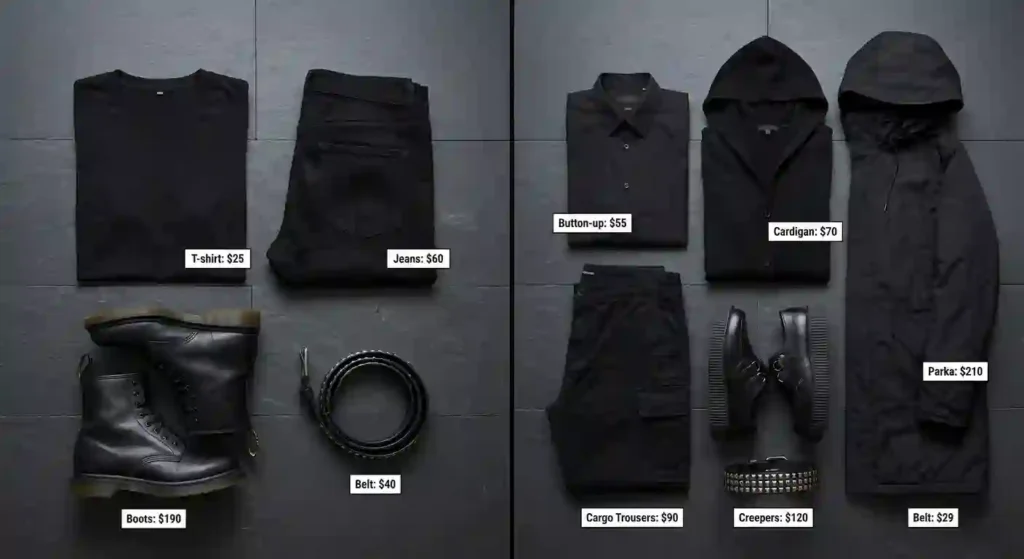
If you are new to goth fashion for men and just starting out with the goth fashion aesthetic, then the short answer is this: your boots are most of the budget and everything else is negotiable. Two builds, both priced from real products.
| Piece | Entry build | Committed build |
|---|---|---|
| Top | Uniqlo U Crew Neck T-Shirt, about $20 (July 2026) | Killstar Crypt Threads Button Up Shirt, $65 (July 2026) |
| Second layer | None | Killstar Assassins Hooded Cardigan, $115 (July 2026) |
| Trousers | Killstar Ebon Bone Jeans, $75 (July 2026) | Killstar Crypt Threads Cargo Trousers, $85 (July 2026) |
| Outerwear | Existing black jacket | Killstar Lost Nostalgia Parka Coat, $165 (July 2026) |
| Footwear | Dr. Martens 1460, $180 (January 2026) | Demonia Creeper-402 leather, $103.95 (July 2026) |
| Hardware | Killstar Gravecast Studded Belt, $40 (July 2026) | Killstar Gravecast Studded Belt, $40 (July 2026) |
| Total | About $315 | About $574 |
The third route is the oldest one. Black secondhand clothing is abundant, black is the easiest color to buy blind, and the Batcave crowd built the entire aesthetic out of what they could find and alter. Buy the boots new and the rest used, and the entry build drops well under $250.
Goth Fashion Men FAQs 2026
Do I have to listen to goth music to try out goth fashion for men?
Anyone can wear black clothing and call it goth clothing, but the goth subculture is historically rooted in music (post-punk, gothic rock, and darkwave). To truly understand the style, it helps to familiarize yourself with the music that birthed it, starting with classic bands like Bauhaus, The Sisters of Mercy, Cocteau Twins, and Christian Death. Wearing the fashion without appreciating the music is often referred to in the community as dark alternative or alternative fashion for men rather than true goth.
Where are the best places to buy men’s goth clothing?
If you want to move beyond fast-fashion alternative labels, look to specialized brands like Disturbia, Shrine (for Victorian and Romantic goth), and Noctex. For footwear, Demonia Cult, T.U.K. Creepers, and Solovair (the original manufacturer of Dr. Martens) are industry standards. Don’t sleep on military surplus stores for heavy trench coats and combat boots, or secondhand platforms like Depop and Grailed for vintage pieces.
How do I dress goth if I have a muscular or larger build?
While classic goth style favors a lean silhouette, men with broader or muscular builds can easily adapt the look. Instead of skin-tight layers, lean into the rugged, hyper-masculine gothic aesthetic championed by icons like Peter Steele of Type O Negative. Opt for straight-leg black denim, structured military-style boots, dark flannels, and muscle-cut black tees or tank tops paired with heavy silver hardware.
Is men’s goth fashion inherently androgynous?
It can be, but it doesn’t have to be. From its 1980s post-punk origins, goth fashion has embraced gender-fluid elements like eyeliner, painted nails, ruffles, and skirts. However, sub-genres like deathrock, corporate goth, and nu goth offer highly structured, traditionally masculine silhouettes if that is your preference. The subculture is historically open-minded, allowing you to dial the level of androgyny up or down to match your personal comfort level.
Is goth fashion still popular?
Yes, the goth fashion men aesthetic still is. In fact, goth fashion for men is hugely popular and is going through a major mainstream resurgence. We’re seeing TikTok and high-profile Instagram influencers presenting their stunning dark aesthetics by integrating it with contemporary style trends. Modern goth fashion is not restricted to a single rigid look. It fractures into multiple and diverse hybrid aesthetics that blend macabre elements with traditional darks, casual streetwear, and everyday outfits.
Do goth men wear makeup?
Some do and many do not. Black eyeliner is the most common, followed by a pale foundation in the trad goth and deathrock sub-genres, where the light-dark contrast is part of the look. Corporate goth and nu goth carry no makeup at all. It is a stylistic option inside the subculture, and plenty of goth men skip it.
Can you dress goth without wearing all black?
Yes. Every sub-genre in the table above carries a second color: burgundy and plum in romantic goth, oxblood in corporate goth, acid green in mall goth, UV neon in cyber goth, lavender and mint in pastel goth. All-black is the default setting, and every sub-genre has a way out of it.
What is the difference between goth and gothic?
Gothic refers to the architecture, the literature and the historical period. Goth refers to the music subculture that began in Britain around 1979 and to the way it dresses. A gothic cathedral and a goth outfit share a mood and almost nothing else.
Are goth fashion styles hard to pull off if you are new to them?
The clothes are easy and the silhouette is not. Most first attempts fail on trouser length, on wearing four textures at once, or on skipping the boots. Fix those three and the look holds together on almost any frame.
SOURCES
- Uncut, “Bauhaus on ‘Bela Lugosi’s Dead’: ‘It was the Stairway To Heaven of the 1980s'”, 2020. https://www.uncut.co.uk/features/bauhaus-on-bela-lugosis-dead-it-was-the-stairway-to-heaven-of-the-1980s-123408/ (Recording date January 1979, release date August 6, 1979, Small Wonder Records; Daniel Ash quote.)
- Far Out Magazine, Kelly Rankin, “The Batcave Club, London: A venue that kickstarted the 1980s goth movement”, October 7, 2020. https://faroutmagazine.co.uk/the-batcave-club-london-goth-movement-1980s/ (Batcave 1982 to 1986, Soho; co-founders Olli Wisdom and Jon Klein; Specimen as house band; coffin entrance; DIY dress driven by cost and scarcity.)
- Wikipedia, “Gothic fashion”, accessed July 13, 2026. https://en.wikipedia.org/wiki/Gothic_fashion (Trad goth definition and creepers/winklepickers; deathrock origins in the Los Angeles punk scene; cybergoth and rivethead origins; Ted Polhemus quotation as cited there.)
- Ted Polhemus, Streetstyle: From Sidewalk to Catwalk, Thames and Hudson, 1994, p. 97 (quoted description of goth dress; accessed via the citation in source 3, not read in the original).
- Valerie Steele and Jennifer Park, Gothic: Dark Glamour, Yale University Press and the Fashion Institute of Technology, 2008 (standard scholarly reference on goth dress; cited for context only, no specific claim drawn from it).
- Killstar US, men’s collection and site navigation, accessed July 13, 2026. https://us.killstar.com/collections/all-mens (Live men’s pricing; the existence of a Corporate Goth edit and a Summer Goth edit; 93 men’s products listed; size run XS to 4XL.)
- Demonia Cult, Creepers collection, accessed July 13, 2026. https://demoniacult.com/collections/creepers-1 (Creeper-602S at $89.95, Creeper-402 leather at $103.95, Creeper-402S suede at $105.95; Demonia identified as a Pleaser USA brand via the site’s wholesale link to pleaserusa.com.)
- Men’s Journal, Michael Charboneau, “Dr. Martens’ Winter-Ready 1460 Boots Are a Rare $50 Off”, January 2, 2026. https://www.mensjournal.com/shopping/dr-martens-1460-slip-resistant-boots-sale (Dr. Martens 1460 standard US price of $180 as of January 2026.)
- Gear Patrol, “One of the Most Iconic Work Boots Ever Made Is Now Quietly More Affordable”, January 15, 2026. https://www.gearpatrol.com/style/dr-martens-i1460-mono-boot-deal/ (Second, independent confirmation of the $180 standard 1460 retail price in January 2026.)
- Uniqlo US, Uniqlo U Crew Neck T-Shirt, accessed July 13, 2026. https://www.uniqlo.com/us/en/products/E433028-000/00 (Listed at $19.90.)
- New Rock, official site, accessed July 13, 2026. https://newrock.com/en (Made in Spain; brand’s own description of its metal-plated boot construction.)
Pingback: Alternative Fashion for Men: The Styles, Explained - Fashionxd.com